
Real pricing data for 14 regulatory change management platforms, from LogicGate at $52K median to MetricStream crossing $1M. What is public, what we reconstructed from funding and filings, and what the vendors refuse to publish.

What Regulatory Change Management Software Actually Costs
If you have ever tried to budget for regulatory change management software, the routine is familiar. You request pricing. Sales sends a Calendly link. Ninety minutes of discovery later, a six-figure proposal lands in your inbox with no benchmark. You have no idea whether the number is fair, generous, or an insult.
We spent a working day pulling every public number for the regulatory change management category we could verify. The result is less a rate card and more a map of what different buyers actually pay, where that data came from, and which vendors keep the numbers genuinely hidden.
This is the sister piece to our breakdown of regulatory intelligence software pricing. That article covered the current awareness and research layer that law librarians and legal analysts live in. This one covers the regulatory change management and horizon scanning workflow layer that compliance officers, chief risk officers, and regulatory ops teams buy to connect obligations to controls inside a regulated enterprise.
Fourteen vendors. Four pricing tiers. One transparent outlier. And a category-defining acquisition that reshaped the top of the market on New Year's Eve 2024.
The Summary: What We Could Verify
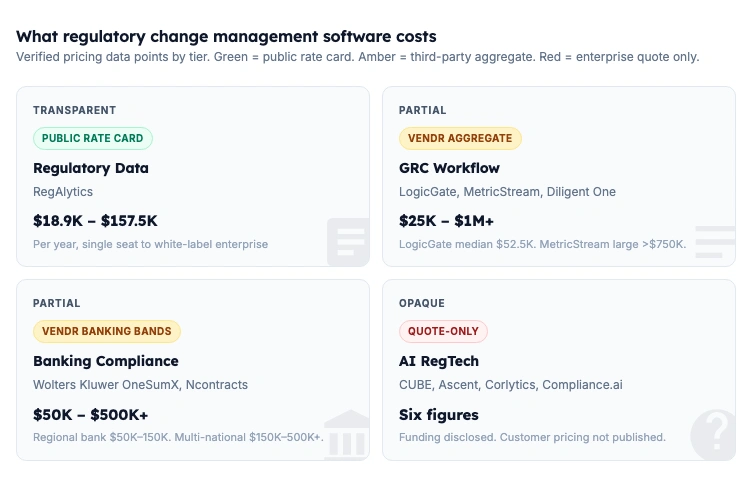
Four vendors have enough public pricing signal to budget from. Five more have third-party aggregate data or SEC-level disclosures that get you within a useful range. The rest are opaque enough that a peer compliance officer's quote is the only reliable benchmark.
| Vendor | Category | Pricing Transparency | Best Public Data Point |
|---|---|---|---|
| RegAlytics | Regulatory data | Public full rate card | $18,900 per seat per year to $157,500 enterprise |
| LogicGate Risk Cloud | GRC workflow | Vendr aggregate (17 deals) | Median $52,567 per year; $25K to $150K+ range |
| Wolters Kluwer OneSumX | Banking compliance | Vendr aggregate | $50K to $150K regional bank; $150K to $500K+ multi-national |
| MetricStream | Enterprise GRC | Third-party aggregate | $75K small; $250K to $500K medium; $750K to $1M+ large |
| Diligent One (HighBond) | GRC platform | Partial third-party | From approximately $5K entry; enterprise custom |
| CUBE (RegPlatform) | AI regtech | Opaque; funding disclosed | Hg-backed, acquired TR Reg Intel Dec 2024, approx. 1,000 customers |
| Corlytics | RegTech roll-up | Opaque; funding disclosed | Verdane majority stake, cornerstone of €1.1B Edda III Fund |
| Ascent RegTech | AI regtech | Opaque; funding disclosed | $19.3M Series B, ING and Wells Fargo on cap table |
| Compliance.ai | AI regtech | Opaque; peer benchmarks | Benchmarked around $15K to $25K per user per year |
| FiscalNote / PolicyNote | Policy | SEC filings | $84.1M ARR / 4,000+ customers = approx. $21K average |
| NAVEX Regulatory Change | Ethics and compliance suite | Opaque | Enterprise quote only |
| SAI360 | Integrated GRC | Opaque | Enterprise quote only |
| Ncontracts | Banking GRC | Opaque | Bank-segment focus |
| Thomson Reuters Regulatory Intelligence | Acquired | N/A | Now sold by CUBE since 31 December 2024 |
Each tier deserves its own breakdown, because the pricing logic and the buyer persona change sharply between them.
Track competitor prices on any website
Changeflow monitors pricing pages and tells you exactly what changed. Set it up in 30 seconds.
Free plan available. No credit card required.
The Enterprise GRC Platform Tier
This is the tier most large banks, insurers, and healthcare systems end up in by default, because regulatory change management is bolted onto a broader governance, risk, and compliance platform rather than sold as a standalone product.
MetricStream
MetricStream sits at the top of the enterprise GRC market. Pricing ranges disclosed through third-party aggregators put deployments in three bands:
- Small enterprise: $75,000 to $150,000 per year.
- Medium enterprise: $250,000 to $500,000 per year.
- Large enterprise: $750,000 to $1,000,000+ per year.
Admin seats sit at $200 to $2,500 per user per app. Implementation for a single module like Audit Management runs around $50,000 as a one-time fee, with ongoing support and maintenance around $20,000 per year. Exact contract pricing is negotiated module-by-module, which is how the enterprise band stretches above the million-dollar mark for a large bank running five or more applications.
LogicGate Risk Cloud
LogicGate is the most transparent of the modern GRC platforms because enough buyers have signed deals through Vendr that a median emerges from the noise. Across 17 tracked deals:
- Median annual contract: $52,567.
- Platform range: $25,000 to $150,000+ per year.
- Entry threshold: approximately $13,765 per year.
- Enterprise ceiling: approximately $130,041 per year.
LogicGate uses a modular pricing structure. You pay for applications, power users who build and manage workflows, and add-ons like API access. Standard users and external users are typically included. Mid-market deployments with five to ten power users and three to five applications land in the $40,000 to $80,000 range on a twelve-month term.
Diligent One Platform (formerly HighBond, formerly Galvanize)
After acquiring Galvanize in 2021, Diligent rolled HighBond into the Diligent One Platform. Pricing is not public, but third-party aggregators list an entry point around $5,000 per year. That number is almost certainly only a starter tier. Firm pricing inside banks and insurers is negotiated per module, per user, and per audit scope. Expect enterprise deployments to run between $100,000 and $500,000 per year depending on how many HighBond modules are live.
NAVEX Regulatory Change Management and SAI360
Both are opaque. NAVEX bundles regulatory change management inside its ethics and compliance suite, which most buyers acquire as part of a broader policy management contract. SAI360 sells integrated GRC to large pharma, financial services, and energy buyers. Neither vendor publishes rate cards and neither has enough Vendr or Gartner Peer Insights data to reconstruct a defensible range. Budget six figures and plan for a multi-month procurement cycle.
The Banking Compliance Tier
This tier exists because regulatory change management for a bank is not really regulatory change management. It is finance, risk, and regulatory reporting with a change tracking module attached. For the broader category context, see our breakdown of banking intelligence and the adjacent compliance monitoring software stack.
Wolters Kluwer OneSumX
OneSumX is the incumbent in the banking finance and regulatory reporting stack. Vendr, which tracks aggregated buyer deal data, publishes the cleanest public range:
- Regional bank deployment: $50,000 to $150,000 per year.
- Multi-national institution: $150,000 to $500,000+ per year.
The median annual cost across all Wolters Kluwer products on Vendr sits at $9,900, but that median pulls in smaller tax and audit products that have nothing to do with OneSumX. The bank-specific ranges above are the right anchor for a compliance officer sizing a contract.
OneSumX for Regulatory Change Management is a specific module inside the broader OneSumX suite, and it is almost always bought alongside OneSumX Reporting or OneSumX Risk. Standalone purchases are rare. Wolters Kluwer also launched an AI-powered OneSumX Reg Manager in 2026, which is being positioned as the horizon scanning and change management layer for banks that already run OneSumX finance and risk.
Ncontracts
Ncontracts is the banking-segment specialist that consistently appears at the top of US community bank and credit union shortlists. Pricing is not public and third-party aggregators have not collected enough deal data to publish a range. Community bank deployments are understood to run into the low five figures per year. Larger bank contracts scale from there but stay well below the enterprise GRC platform tier.
The AI RegTech Tier
This is the tier venture capital built. Each of the companies below pitched itself as the AI-native replacement for the legacy banking compliance stack, each raised significant funding, and each has different pricing because it targets a different slice of the buyer base.
CUBE
CUBE is the most important story in this category right now. On 31 December 2024, CUBE completed the acquisition of Thomson Reuters Regulatory Intelligence and the Oden businesses, instantly absorbing the largest incumbent content library in the market. The deal terms were not disclosed. The structural result is unambiguous: CUBE's customer base expanded to approximately 1,000 customers across banking, insurance, asset management, payments, and adjacent regulated sectors. Its headcount passed 600 employees, of whom about 250 are regulatory subject matter experts. CUBE had already acquired Reg-Room in 2024 to extend its horizon scanning capabilities, positioning the combined platform as the single place where regulated enterprises can run both change management and forward-looking regulatory intelligence.
CUBE is backed by Hg Capital, which invested in March 2024 through the Hg Mercury 4 Fund and Hg Capital Trust. Pricing is not public. Enterprise contracts for a multinational bank using RegPlatform plus the former Thomson Reuters Regulatory Intelligence content library will run well into six figures, and for the largest global banks into seven.
The acquisition also matters for buyers already running TR Regulatory Intelligence. Your vendor is now CUBE. Your pricing benchmark is whatever CUBE negotiates at renewal. Compliance teams evaluating alternatives tend to start with our Thomson Reuters alternative comparison before running a competitive bid.
Ascent RegTech
Ascent raised a $19.3 million Series B led by Drive Capital, with ING and Wells Fargo participating alongside Series A investors Alsop Louie and the University of Chicago. That investor list is revealing. Wells Fargo and ING are not typically venture LPs. Their participation indicates Ascent had signed meaningful enterprise contracts with both banks. Ascent pitches seven and eight figure compliance savings per customer, which is the number a $10 million-plus enterprise contract would justify. Pricing is not public. Expect AI regtech-tier contracts starting in the low six figures per year and scaling with jurisdiction and obligation volume.
Corlytics
Corlytics is the Dublin-based regulatory intelligence specialist that became a roll-up. Verdane, a European growth specialist, took a majority stake in April 2024 as the cornerstone investment of its €1.1 billion Edda III Fund. PitchBook reports total funding of approximately $35.1 million prior to and including the Verdane transaction. Corlytics has since positioned itself as a category consolidator, which usually precedes further acquisitions. Its horizon scanning product sits alongside the change management module and is pitched as the forward-looking half of the stack. Pricing is not published. Bank-tier contracts are understood to sit in the same band as CUBE, which is low six figures at the entry end and scaling substantially for multinationals.
Compliance.ai
Compliance.ai is more transparent about its positioning than its pricing. The platform targets banking, financial services, and insurance buyers with an AI layer over a curated regulatory content set. Peer benchmarks from similar AI regtech platforms suggest contracts in the range of $15,000 to $25,000 per user per year on multi-year deals, scaling by jurisdiction coverage. A mid-market deployment of 10 to 15 users implies a contract value between $150,000 and $375,000 per year.
The Policy and Legislative Tier
FiscalNote and PolicyNote
FiscalNote is the one name in this section with real SEC-level financial disclosure, because it went public via SPAC in 2022 and remained subject to disclosure rules until going private in 2024. From the most recent public filings:
- FY2025 revenue: $95.4 million.
- FY2025 ARR: $84.1 million.
- Customer count: 4,000+.
- Net revenue retention: approximately 96%.
Divide ARR by customer count and the average customer pays approximately $21,000 per year. That average hides enormous variance. Government agency and multi-national enterprise contracts run into six figures. PolicyNote's self-serve Platform Only tier almost certainly sits in the low four figures. The range inside FiscalNote's customer book spans roughly 100x.
PolicyNote publishes three tiers (Platform Only, Essential, Advanced) but no dollar amounts. Every tier still requires a demo. Buyers looking for a FiscalNote alternative tend to land on Quorum or more focused agency-monitoring tools.
The Transparent Outlier
RegAlytics
RegAlytics is the only vendor in this category that publishes a complete rate card. The numbers are specific enough to plan a budget from today:
- Essentials (freemium): $49.99 per month; 90-day alert history; no API.
- Single Seat (annual): $18,900 per year.
- Team (8 licenses, annual): $37,800 per year.
- Unlimited licenses (annual): $60,480 per year.
- Enterprise with API (annual): $107,100 per year.
- White-label Enterprise (annual): $157,500 per year.
Add-ons are also published. $500 per extra license, $25 per URL onboarding request, $500 per Chatbot user for beta access. This is what pricing transparency looks like in a category this opaque. Every other vendor on this list could publish a comparable rate card and has chosen not to.
Why This Market Is This Opaque
Six reasons, in rough order of how much each contributes to category-wide pricing opacity.
1. Buyer heterogeneity. A community bank, a regional insurer, a global asset manager, and a multinational bank each have wildly different regulatory footprints. Vendors want the ability to charge each one differently. Published pricing would force a narrower band and lose the ceiling.
2. Jurisdiction-based pricing. Most of these platforms charge by how many jurisdictions and agencies a customer wants to monitor. A single-country US regional bank costs a fraction of what a pan-European multi-jurisdictional investment bank costs. A rate card would need a matrix and no vendor wants to publish the matrix.
3. Bundling with risk and reporting. Wolters Kluwer bundles regulatory change management inside OneSumX finance and reporting. Diligent bundles it inside HighBond audit. Standalone pricing creates a benchmark that embarrasses the bundle and no incumbent wants that internal comparison.
4. Long procurement cycles. Most of these contracts go through bank IT procurement plus compliance sign-off plus legal review. The cycle is long enough that sales-led custom pricing is not a friction, it is the default. Buyers who do not want a demo cycle are not the target buyer.
5. Switching costs. A bank on OneSumX has obligations mapped to controls inside OneSumX. Switching to MetricStream or CUBE is a multi-year migration. High switching costs support opaque pricing because buyers cannot credibly walk away.
6. Nobody is forcing transparency. Vendr, Gartner Peer Insights, and procurement benchmarking services collect some data. G2 and TrustRadius aggregate reviews without rates. None of these has enough critical mass in RCM specifically to force vendors to publish. RegAlytics has the opportunity to shift category norms, but so far the bigger players have not followed.
The Layer Nobody Prices For
Look carefully at every vendor above. MetricStream, LogicGate, CUBE, Wolters Kluwer, Corlytics, Ascent, Compliance.ai, NAVEX, SAI360, Diligent, Ncontracts, FiscalNote, RegAlytics. Every one of them works from a curated regulatory content feed. Every one of them depends on the feed catching the change.
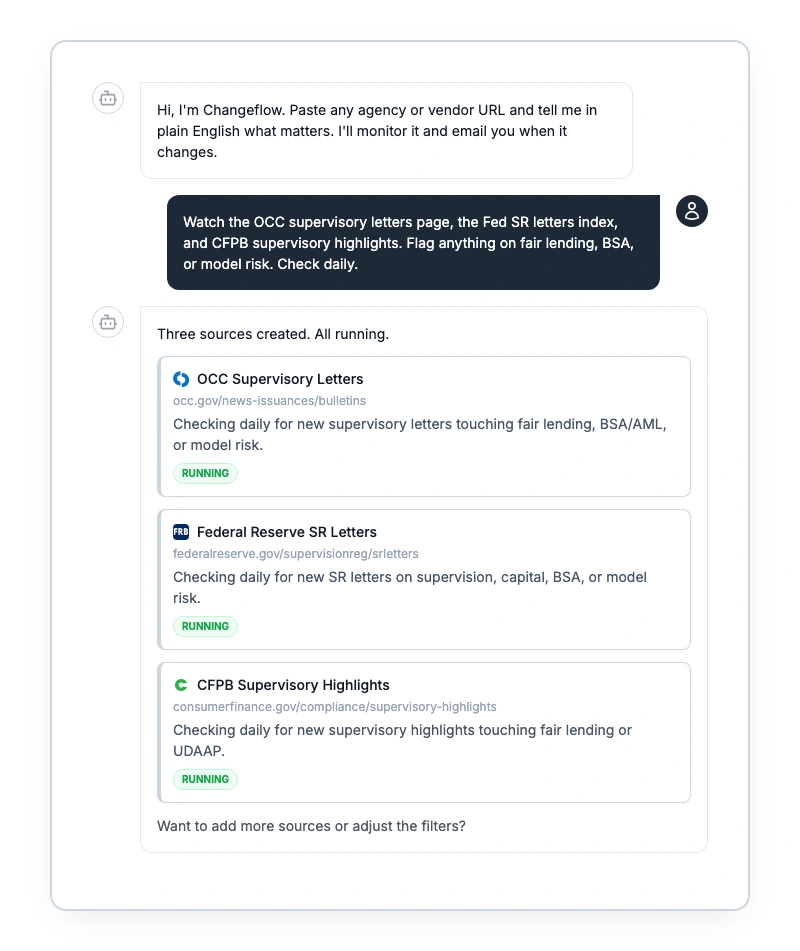
The gap is what the feed does not catch. Agency guidance pages that get edited without a press release. FDA warning letter indexes that add a new entry. SEC staff interpretations that get revised in place. OCC supervisory letters that get appended to an existing page. State attorney general interpretive guidance. CFPB supervisory highlights. FERC filing indexes. The quiet, unpublicized changes on government websites that compliance and legal teams are genuinely paid to notice.
This is the regulatory intelligence dark matter that the major RCM platforms do not cover, because their content teams are focused on the formal rulemaking pipeline and the press release feed. A bank needs to know about both layers. The formal layer is well served. The quiet layer is the layer of regulatory change tracking for financial services that everyone pays for and nobody actually gets.
Changeflow watches those pages. You point it at an agency URL, describe what matters in plain English, and it reads the page. Alerts link straight to the primary source with no content licensing in the way. Pricing is public on the Changeflow pricing page.
The opacity elsewhere in this stack has structural reasons. The layer we cover does not have those reasons, so we price it in public.
Bottom Line
- Four vendors have enough data to budget from today: RegAlytics (full rate card), LogicGate (Vendr median), Wolters Kluwer OneSumX (Vendr by bank size), MetricStream (third-party enterprise bands).
- Five have enough public funding, SEC, or peer-benchmark data to estimate: CUBE (Hg investment, TR Reg Intel acquisition), Corlytics (Verdane majority), Ascent (Series B), Compliance.ai (peer benchmarks), FiscalNote / PolicyNote (SEC ARR).
- Five are genuinely opaque: NAVEX, SAI360, Ncontracts, Diligent One beyond the entry tier, and the legacy Thomson Reuters Regulatory Intelligence product now sold by CUBE.
- The category is structured for opacity through buyer heterogeneity, jurisdiction-based pricing, bundling, procurement friction, and the absence of a transparency forcing function.
For a compliance officer, chief risk officer, or regulatory ops lead, the practical move is to shortlist one enterprise GRC platform (MetricStream, LogicGate, or Diligent), one horizon scanning and current awareness feed (CUBE, Corlytics, or RegAlytics), and one agency-page monitor for the dark matter layer. The last of those does not need to cost five figures. The other two very much do.
For law firm librarians running current awareness programs or general counsel comparing across categories, the RCM tier overlaps with the regulatory intelligence tier but serves a different buyer. Both are useful. Neither is cheap. Both have a layer underneath that nobody prices for, and that is where a lot of the real regulatory surprise actually lives.
The layer nobody prices for
RCM platforms stop at the published regulatory text. Changeflow watches the agency pages that change without a press release. Pricing is public.
Try Changeflow FreeNo credit card required
More from Learn

Wayback Machine for Legal Research: A Law Librarian's Guide
Half the URLs in old briefs are dead. Here is how law librarians use the Wayback Machine and stronger archives to verify citations, build timelines, and support litigation.

Law Librarian Current Awareness Audit Checklist (2026)
A 27-question audit covering coverage, cadence, relevance, distribution, resilience, and value. Built for law librarians and knowledge lawyers running current awareness at Am Law 200 firms.

Audit-Ready Web Archives: SEC 17a-4, FDA, and HIPAA Rules
Free archive tools fail under regulatory audit. Here is what SEC 17a-4, FDA 21 CFR Part 11, and HIPAA require from a web archive that holds up under examination.