
Law librarians spend under 5 hours a week on current awareness. Here's the workflow, the tools, and the agency-website layer that Westlaw and Vable miss.

How Law Librarians Automate Current Awareness
A law librarian at an Am Law 200 firm supports between 100 and 300 attorneys. They run under 5 hours a week on current awareness. Inside that window they scan regulators, courts, news, and industry content. They filter by practice group. They write short notes on why each item matters. They push it out. Then they go back to reference requests, database training, and cost recovery reports.
This is skilled work compressed into a tiny time budget. Most articles about current awareness get this wrong. They list tools. They don't look at the actual workflow or the gaps inside it.
This guide does both. It covers the real current awareness stack law librarians use today, where that stack falls short, and how to plug the gap without adding another platform to the pile. If your work crosses into regulatory change management, court website monitoring, or tracking government agency pages, this is the playbook.
In this guide:
- What current awareness actually means in a law firm setting
- The daily workflow and where time disappears
- The Tier 1 through Tier 4 tool stack most firms actually run
- What every one of those tools misses (and why)
- How to set up monitoring by practice group
- How to keep trust with detail-oriented attorneys
What Current Awareness Means (And Why It Matters)
Current awareness is the daily scan-filter-distribute loop. The librarian watches legal, regulatory, and business developments, decides what matters for each practice group or client, writes a short contextual note, and pushes it out.
The BIALL 2025 Law Firm Library Survey puts it bluntly: 95% of librarians do current awareness. It is nearly universal even when it isn't written into the job description. AALL's 2025 State of the Profession report shows library and knowledge management spend rising 15.2% at Am Law 200 firms. The function is expanding, not shrinking.
What changed? Two things. Regulatory activity keeps increasing across every industry. And attorneys will not tolerate a firehose of raw alerts any more. They want pre-filtered briefings they can skim over coffee. The person doing that filtering, in most firms, is the librarian.
Paste a URL. We'll do the rest.
Changeflow monitors the page and tells you what changed and why it matters.
Free plan available. No credit card required.
The Daily Workflow
Here's what a typical morning looks like for a firm librarian covering current awareness:
- Morning scan. Check overnight alerts from Westlaw, Lexis, Bloomberg Law, Vable or Manzama, and Google Alerts. Also sweep practice-specific sources: Law360 practice newsletters, SEC press releases, FDA warning letters, regulator bulletins.
- Filter and curate. Decide what's relevant to which practice group. Tax team doesn't need FDA warning letters. IP team doesn't need tax guidance. Corporate needs M&A deal commentary. Litigation needs court opinions in relevant jurisdictions.
- Summarize. Write a sentence or two on each item explaining why it matters. This is the librarian's value-add. It's not a headline, it's a "so what" note.
- Distribute. Push to attorneys and practice groups via email. Maybe a SharePoint intranet post. Maybe a Teams channel. Email is still primary.
- Respond to requests. "Can you set up an alert for crypto enforcement?" "Can you add patent opposition decisions to my feed?" Constant configuration tweaks.
- Maintain. Adjust saved searches. Retire dead feeds. Add new sources when an attorney picks up a new client industry.
Vendor case studies routinely show this at scale. Firms running 500+ alerts across the librarian team before consolidation are not unusual. The maintenance load alone consumes much of the available hours.
Current awareness is rarely a dedicated role. It sits alongside reference, KM, competitive intelligence, and BD support. Only the largest firms have a dedicated current awareness librarian.
The Tool Stack Firms Actually Use
There's no single "current awareness tool" at a law firm. It's a layered stack. Here's what that stack looks like at a typical Am Law 200 firm.
Tier 1: Research Platforms With Alert Features
These are the flagship research platforms that every firm librarian uses daily. All of them have built-in alerting.
- Westlaw Precision (Thomson Reuters). KeyCite alerts for citation changes. Publication alerts for journals and treatises. WestClip runs a saved search and notifies you of new matches.
- Lexis+ AI (LexisNexis). Automated search alerts. Shepard's alerts for citation health. Coverage is co-dominant with Westlaw.
- Bloomberg Law (Bloomberg). 16 Practice Center topic pages, each with a curated newsletter. Especially strong for transactional and securities work.
- vLex / Fastcase (vLex). Vincent AI for cross-jurisdictional research. Available free through many bar association memberships.
These are the foundation. But they mostly alert you to content in their own databases. They don't watch the open web.
Tier 2: Dedicated Current Awareness Platforms
This is where the librarian assembles the daily briefing.
- Vable (Vable). Content aggregation, branded newsletter creation, alert management. Reed Smith, WFW, and Williams Mullen all run on Vable.
- Manzama (Diligent). NLP-powered intelligence feeds across 75,000+ sources. Group profiles covering client, topic, and practice area. Gowling WLG uses Manzama group profiles to send one consolidated daily email per fee earner.
- Nexis Newsdesk (LexisNexis). News monitoring with copyright-compliant distribution.
- Law360 (LexisNexis). 40+ practice area daily newsletters. Effectively the industry standard for US legal news.
Pricing is enterprise-only. Most of these run into five figures annually.
Tier 3: Free and Low-Cost Supplements
- Google Alerts. Still the most common free layer. Unreliable for long-tail agency content but catches broad mentions.
- Feedly. RSS aggregation. Used more for librarian personal monitoring than firm-wide distribution.
- SmartCILP (University of Washington Law Library). 600+ legal publications, 104 subject headings, personalized email delivery.
Tier 4: Regulatory-Specific
- LexisNexis State Net. 150,000+ legislative measures and 50,000+ regulatory measures tracked globally.
- Bloomberg Government (BGOV). Federal policy and legislative intelligence.
- FiscalNote PolicyNote. AI-powered legislative and regulatory prediction.
- RegAlytics. Regulatory data feeds covering 8,000+ agencies, sold primarily to financial industry compliance teams.
- Mondaq. Legal updates and commentary aggregated from law firms globally.
The typical firm librarian runs across at least one tool from each tier. Often five or more in combination.
What the Stack Misses
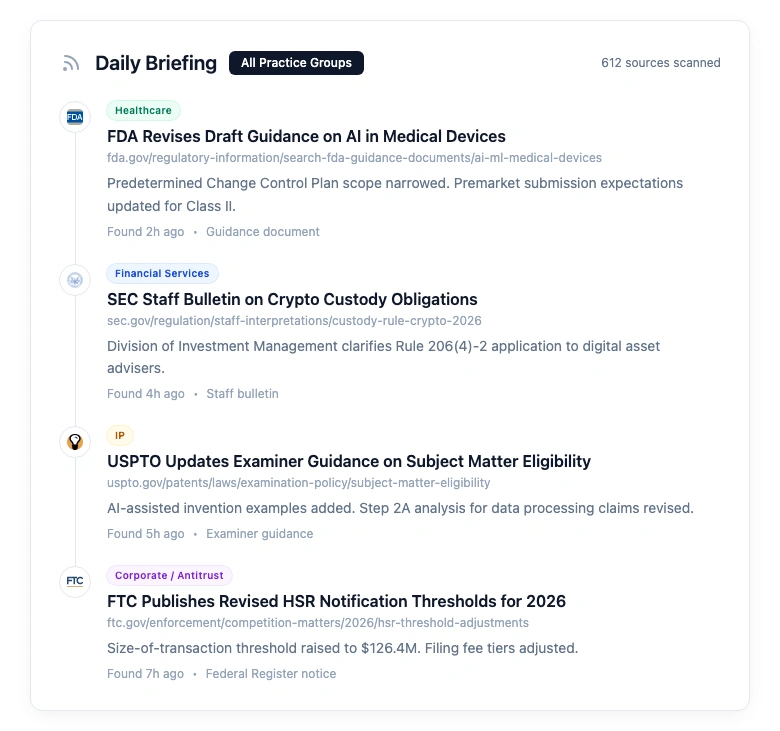
Here's the honest gap analysis. Every tier above has a blind spot when it comes to agency websites.
Research platforms index formal publications: case opinions, statutes, final rules. They don't watch the hundreds of guidance documents, staff bulletins, and FAQ pages on the regulator's actual website.
Current awareness platforms like Vable and Manzama pull from RSS feeds, news sources, and law firm publications. If a regulator publishes a guidance update as a PDF buried three clicks into its site with no RSS feed, it does not appear.
Law360 and Mondaq are news and commentary. Their reporters eventually cover significant agency actions, but often days or weeks after the agency posted them. "Eventually" is too late for a compliance team or anyone running compliance monitoring software on behalf of one.
State Net and BGOV cover the legislative and formal regulatory pipeline. They miss the sub-regulatory layer where most practical guidance actually lives.
This is what the Slaw article from the Canadian Bar identifies as the core gap in library current awareness: monitoring agency web content is largely invisible to the existing stack. An SEC staff bulletin on crypto custody. An FDA draft guidance on AI in medical devices. An OCC update to its examination handbook. A CFPB blog post signaling enforcement priorities. These are the changes that affect day-to-day practice, and they live on agency websites, not in any database.
The Pain Points Nobody Solves
Reading current-awareness vendor case studies, the same complaints appear over and over. Not because the platforms are bad. Because the job is fundamentally hard.
Setup time. Hundreds of sources to configure, 20 minutes each. The librarian runs out of hours before they run out of sources worth watching.
Capacity limits. Teams hit capacity and start pushing back on requests, limiting the scope of the service. Current awareness does not scale linearly with librarian hours.
Continuity risk. Each team member owns a portfolio of sources; providing annual leave cover is a challenge. When one librarian owns a set of sources, holiday coverage breaks the service.
Volume fatigue. The more emails the library sends out, the more likely they are to be unread. More is not better. Consolidation wins.
Information overload. There is an academic paper with exactly that title in Legal Reference Services Quarterly. It is a real, named phenomenon in the profession.
FOMO. The other side of volume fatigue. The fear of missing vital information drives adoption of consolidated alert platforms. Too much and attorneys tune out. Too little and the firm looks unprepared. Both failure modes are real.
Practice Group Routing
The biggest time saver a librarian can make is shifting from topic alerts to group profiles.
Topic alerts mean a saved search per topic, delivered to a distribution list. You end up with 500 alerts flying around the firm. Most attorneys ignore most of them.
Group profiles map each practice group to its full set of relevant regulators, courts, topics, and clients. The librarian curates what matters for that group daily. Each attorney gets one consolidated email covering everything they care about.
Gowling WLG runs this model on Manzama. A corporate partner gets one email covering all their clients, their sectors, and their practice topics. Not 30 separate alerts.
The mapping work is upfront but pays back permanently:
| Practice Group | Regulators to Watch | Courts | Topics |
|---|---|---|---|
| Corporate / M&A | SEC, FTC, CFIUS, state securities | Delaware Chancery, SDNY | Deal commentary, antitrust |
| Financial Services | SEC, CFPB, OCC, FDIC, FINRA, Fed | SDNY, DDC | Capital requirements, enforcement |
| Healthcare | FDA, CMS, HHS, OCR, DOJ Healthcare Fraud | Federal district courts | Approvals, warning letters, fraud settlements |
| IP | USPTO, EPO, ITC, PTAB | Federal Circuit, ITC | Patent grants, oppositions, trademark watches |
| Tax | IRS, Treasury, state tax authorities, OECD | Tax Court | Revenue rulings, notices, international |
| Employment / Labor | EEOC, NLRB, DOL, OFCCP | Circuit courts | Guidance, enforcement, DEI |
| Environmental | EPA, state DEQs, DOE, FERC | DC Circuit | Enforcement, permitting, climate rules |
Once the mapping exists, the librarian has a playbook for what to monitor on behalf of each group. That playbook is the product. The platform underneath is interchangeable. The same approach scales to website monitoring for law firms more broadly, not just the library function.
Trust Through Transparency
Law librarians are not data analysts. They are forensic researchers. Attorneys pay expensive rates to rely on what the library hands them. A librarian who sends out an auto-summarized digest without showing their work loses credibility fast.
This is why every AI-assisted current awareness tool has to show the audit trail. Not as a nice-to-have. As a trust requirement.
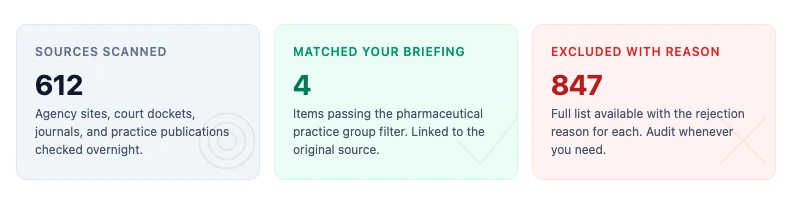
What the audit trail should include:
- The total number of sources scanned
- The number of items rejected and why
- The number of items matched and surfaced
- A link to every original source for each item
- The rationale for inclusion ("matched the IP group profile on term: biosimilar labeling")
Greg Lambert at Jackson Walker built a GPT prototype that auto-summarized RSS feeds for under a dollar over five days. The profession is AI-ready. But "AI-ready" means the AI shows its work. The librarian needs to grade the AI's homework before it goes out. That is trust through transparency, not trust through marketing.
Fitting New Tools Into the Stack
Any new current awareness tool at an Am Law firm has to live inside the Microsoft 365 and iManage ecosystem or it dies on the vine. The ILTA 2025 survey found 74% of firm libraries on SharePoint and 63% on Teams. iManage holds roughly 51% DMS share at large firms. Outlook is universal.
Practical implications for adopting any new monitoring source:
- Email first. The deliverable has to be an email that renders perfectly in Outlook. Dashboards are optional. Email is not.
- Mobile-friendly. Partners read email on phones on the way to court. If it doesn't work on mobile, it's not a current awareness product.
- RSS or API out. Vable and Manzama can ingest RSS from any source. A new tool that exposes a clean RSS feed plugs directly into the existing current awareness stack without ripping anything out.
- iManage saveable. If the librarian can file a briefing email into the matter workspace in iManage, it becomes research evidence, not ephemeral email. It also survives as ediscovery-ready archive if a matter later needs proof of what the agency said on a given date.
- Teams channel hook. For urgent items, a Teams channel notification to a practice group is faster than email.
The librarian's job is not to run a new platform. It's to plug new sources into the existing rails.
Where Changeflow Fits
The gap is the agency page itself.
Most regulatory tools miss the guidance, FAQ, and policy pages where practical compliance content lives. Westlaw and Bloomberg Law index formal rules and case law. Vable and Manzama aggregate news and published articles. None of them sit on the agency's own website waiting for a guidance document, an FAQ answer, or a staff bulletin to change.
Changeflow lets the librarian track any website by URL, describe in plain English what matters, and the AI reads the page on a schedule. Change detection and alerts fire when the described content appears or changes. From $99 per month. A familiar category if you've used a Visualping alternative before, just with practice-group routing and AI summaries layered on top.
Typical pages a librarian points it at: a state insurance commissioner's bulletin page, an SEC staff guidance landing page, an FDA guidance document library, a niche federal advisory committee site, a foreign regulator's English-language portal, a client's public filings landing page. The output (RSS, email, Teams webhook) plugs into the existing current awareness platform without ripping anything out. Not a replacement for Vable or Manzama. A complementary source that feeds into them.
Measuring What Works
Law librarians are measured on what attorneys notice. That's a problem, because the best current awareness work is invisible. The attorney doesn't say "thank you for the FDA warning letter alert." They notice when something was missed.
A few metrics that actually matter:
- Time-to-alert. From agency publication to attorney inbox. Under 4 hours is good. Under an hour is the benchmark.
- Signal density. Percentage of items in the daily briefing that attorneys click. Low click rate means the filter is too loose.
- Attorney opt-out rate. If attorneys are asking to be removed from distribution lists, the volume is too high.
- Partner-initiated add requests. "Can you add X to my feed?" These are the signal that the service is trusted enough to expand.
Track these monthly. Share with the library director. Use them in the annual budget conversation.
Frequently Asked Questions
What does a law librarian mean by current awareness?
Current awareness is the daily practice of scanning legal, regulatory, and market developments and pushing what matters to attorneys. It covers case law, legislation, agency guidance, regulator enforcement, industry news, and competitive intelligence. The librarian curates, writes short context notes, and distributes by practice group, client, or topic.
How much time do law librarians spend on current awareness?
LAC Group research across roughly 30 firms found most librarians spend under 5 hours per week on current awareness, even though 95% of librarians do it. It usually sits alongside reference, research, KM, and competitive intelligence duties. Only the largest firms have a dedicated current awareness role.
What tools do law librarians use for current awareness?
The core stack includes Westlaw, Lexis+, and Bloomberg Law for alerts on case law and formal rules. Vable and Manzama are the enterprise current awareness platforms. Law360 and Nexis Newsdesk cover news. Free tools like Google Alerts, Feedly, and SmartCILP supplement. Most firms use five or more in combination.
What do current awareness platforms miss?
Vable, Manzama, and Nexis are aggregation layers over news and published content. They do not watch agency websites for quiet updates, guidance document edits, FAQ changes, or policy shifts that never get published as articles. That is where Changeflow fits. It watches the agency page directly.
How should a law librarian organize alerts by practice group?
Group profiles beat individual alerts. Map each practice group to the regulators, courts, and topics they cover. Run one consolidated daily briefing per group rather than 20 separate alerts. Gowling WLG uses Manzama group profiles to send fee earners a single daily email covering all their clients, sectors, and topics.
The Librarian Is the Product
The current awareness platform is the pipes. The librarian is the product.
Nothing about automation changes that. A well-configured Manzama group profile with Changeflow watching the agency-page layer still needs a human deciding what's relevant for the corporate partner this morning. That curation judgment is the skilled work. The tooling just gets the raw material into the librarian's hands faster, with fewer gaps, with the audit trail intact.
That's the job description for 2026. Find the gaps in the stack. Fill them with the right source, not another platform. Keep the audit trail visible. Consolidate before the attorney's eyes glaze over.
Five hours a week. One hundred to three hundred attorneys. That's the math. The tools serve the math, not the other way around.
Monitor the pages Westlaw and Vable don't cover
Point Changeflow at any agency URL, describe what matters, and the AI reads it for you. Built for the agency-page layer Westlaw and Vable don't cover.
Try Changeflow FreeNo credit card required
More from Learn

Wayback Machine for Legal Research: A Law Librarian's Guide
Half the URLs in old briefs are dead. Here is how law librarians use the Wayback Machine and stronger archives to verify citations, build timelines, and support litigation.

Law Librarian Current Awareness Audit Checklist (2026)
A 27-question audit covering coverage, cadence, relevance, distribution, resilience, and value. Built for law librarians and knowledge lawyers running current awareness at Am Law 200 firms.

Audit-Ready Web Archives: SEC 17a-4, FDA, and HIPAA Rules
Free archive tools fail under regulatory audit. Here is what SEC 17a-4, FDA 21 CFR Part 11, and HIPAA require from a web archive that holds up under examination.