
Most SaaS vendors update their ToS, DPA, and sub-processor lists without telling you. Here's how legal ops teams catch the changes that matter.

How to Monitor Terms of Service Changes From Every Vendor
A mid-market company runs on 250 SaaS vendors. An enterprise runs on 1,000. Each one has a Terms of Service, a Privacy Policy, a Data Processing Agreement, a sub-processor list, an Acceptable Use Policy, and a Service Level Agreement. All of them can be edited without warning. Fewer than 25% of vendors send a customer notification when they do.
That is the gap. You signed an MSA with a vendor 18 months ago. Since then they have updated their public DPA twice, added three sub-processors, rewritten the AI training clause, and quietly shortened the breach notification window from 72 hours to "promptly." Your signed contract still says what it said. The public layer, which most vendor contracts incorporate by reference, has drifted.
This guide shows how legal ops, procurement, and privacy teams actually monitor terms of service changes across a vendor stack of any size. It covers what changes to watch, why vendors don't tell you, and how to automate the workflow without adding another platform to the contract.
In this guide:
- What actually changes in a vendor's public policies
- Why vendor notification is broken (and GDPR's narrow fix)
- The 8 vendor page types a legal ops team should watch
- How to set up monitoring by vendor, by document, or by clause
- How this fits with your CLM and TPRM processes
What Changes in a Vendor's Public Policies
The phrase "terms of service" gets used loosely. Inside a serious vendor management workflow, it splits into seven or eight separate document types, each with its own cadence and its own compliance weight.
Here is the standard set, drawn from tracking 200 top B2B SaaS vendors:
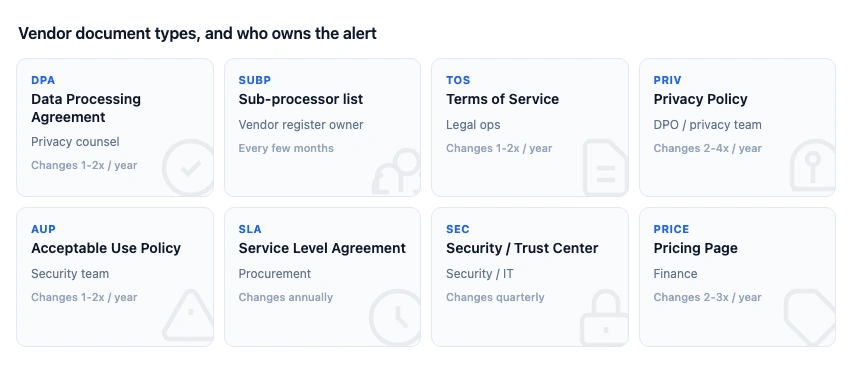
- Terms of Service (TOS). Pricing terms, liability caps, indemnification, data ownership, termination rights, auto-renewal, arbitration, governing law, AI/ML usage clauses. Changes 1-2 times per year on average.
- Privacy Policy (PRIV). Data collection categories, third-party data sharing, retention periods, cross-border transfers, tracking technologies, AI training data. Changes 2-4 times per year.
- Data Processing Agreement (DPA). Processing scope, sub-processor approval, breach notification timelines, audit rights, Standard Contractual Clauses, deletion SLA. Changes 1-2 times per year. GDPR-critical.
- Sub-processor list (SUBP). New sub-processors added, processors removed, processing locations, new AI sub-processors like OpenAI or Anthropic. Changes every few months. Highest compliance value.
- Acceptable Use Policy (AUP). Usage restrictions, prohibited use cases, rate limits, AI-generated content policies, security testing rules. Changes 1-2 times per year.
- Service Level Agreement (SLA). Uptime guarantees, service credit math, support response times, maintenance windows, exclusions. Changes annually.
- Security / Trust Center (SEC). SOC 2, ISO 27001, HIPAA, FedRAMP status, encryption standards, incident response procedures. Changes quarterly.
- Pricing Page (PRICE). Price increases, plan restructuring, feature moves between tiers, deprecated plans, usage limits. Changes 2-3 times per year.
Each document type tells you something different. A sub-processor addition is a privacy and security signal. A TOS liability change is a legal signal. An SLA exclusion is a procurement signal. The same vendor might ship all three in a single quarter without sending a single email.
Monitor regulatory pages automatically
Changeflow watches agency websites and tells you what changed and why it matters.
Free plan available. No credit card required.
Why Vendor Notification Is Broken
The B2B SaaS model runs on asymmetric contract updates. Every standard MSA includes language like: "Vendor may update these terms from time to time. The updated version will be posted at the URL above. Continued use of the Service constitutes acceptance."
In practice this means the vendor decides, unilaterally, when and how much to tell you.
Research on SaaS vendor behavior keeps finding the same number. Fewer than one in four vendors actually emails customers when they change their public terms. Most rely on the "post to website, effective immediately" clause. Some send an annual summary. A few, mostly AWS, Google Cloud, and Microsoft, maintain change feeds or version archives that help. Most don't.
GDPR carved out one narrow fix. Article 28(2) requires processors to give controllers "prior specific or general written authorisation" before adding or changing sub-processors. In practice this has been implemented as a public sub-processor list plus an RSS feed or email subscription, with a 30-day objection window. That is the only place where the regulation forces notification. Everything else in the DPA, the AUP, the SLA, the privacy policy, is still "check the page yourself."
That is why regulatory change management alone is not enough. Government websites are one half of the compliance surface. Vendor websites are the other. The regulatory half (FTC, state AG, EDPB, ICO enforcement and guidance pages) needs its own monitoring layer; pair that with vendor-page monitoring and you cover both sides of the privacy obligation.
The Scale Problem
Manual review works when you have 20 vendors. It collapses at 200.
A typical mid-market compliance team might own DPA review for 80-150 vendors. An Am Law 200 firm's legal ops function might oversee 300+. A listed enterprise often crosses 1,000. Each vendor has 5-8 pages worth monitoring. That is 500 to 8,000 pages to check, in a world where any one of them can change any day.
The typical fallbacks each have a problem:
- Annual vendor reviews. Miss 11 months of changes out of 12.
- Spreadsheet of URLs. Works for 50 vendors, breaks at 200, and nobody clicks through.
- Google Alerts. Only surfaces news, not the page itself. Silent on 90% of policy edits. See our guide on Visualping alternatives for why news-shaped tools miss page-shaped changes.
- Vendor email notices. Only work for the 25% of vendors that actually send them.
- CLM alerts. Only fire on your signed contract anniversary, not on the public page drift.
This is why compliance monitoring software has become its own category. The job is not "read all the contracts once." It is "watch thousands of public pages continuously and surface the diff." Most teams land on a dedicated change detection workflow once they hit the 150-vendor mark.
What Legal Ops Teams Actually Track
In practice, teams break the work into three tiers.
Tier 1: Critical path vendors
The 10-30 vendors that store regulated data, touch critical infrastructure, or carry the biggest spend. AWS, Azure, GCP, Salesforce, Workday, ServiceNow, Snowflake, the core CRM, the core ERP. You monitor every document type for these. DPA changes go straight to privacy counsel. Sub-processor additions trigger a review against your approved list. TOS changes go to legal ops for redline comparison.
Tier 2: Sensitive data vendors
The next 50-150 vendors that process customer data, PHI, payment data, or employee data. Monitoring focuses on DPA, sub-processors, privacy policy, and security pages. AUP and SLA are secondary. TOS gets reviewed annually unless an alert fires.
Tier 3: Everything else
The long tail. Design tools, internal productivity apps, small vertical SaaS. Monitoring focuses on sub-processors and DPA only, because those are the GDPR-critical signals. The rest gets reviewed only if procurement re-opens the contract.
This three-tier split is how teams keep the workload finite. Without tiering, you end up watching 5,000 pages and reading none of them.
Mapping Changes to Actions
Monitoring is only useful if every detected change routes to someone who can act on it. The mapping usually looks like this:
- DPA change → privacy counsel reviews for GDPR/CCPA impact. New SCCs or deleted SCCs trigger legal review.
- Sub-processor added → compare against approved list. If new, trigger 30-day objection review. Log in vendor register.
- Privacy policy change → review data sharing categories, retention changes, AI training clauses. Flag to DPO if cross-border transfer terms moved.
- TOS change → legal ops diffs against the signed MSA. If the public layer drifts from the negotiated layer, flag for contract amendment or enforceability memo.
- AUP change → Flag to security team if prohibited uses expanded (common now for AI content and security testing).
- SLA change → Procurement checks service credit math and new exclusions against business-critical workloads.
- Security/Trust change → Security team verifies certifications are still current. Lost SOC 2 is a signal.
- Pricing change → Finance models the impact. Auto-renewal clauses mean price increases can land silently.
If you can't route the alert, don't set it up. Alert fatigue is the fastest way to kill this workflow. The same discipline regulatory compliance examples use for regulator sources applies here: brief tightly, route clearly, archive the rest.
How Changeflow Fits
Most of our regulated-industry customers arrived from the government side. They wanted to track FDA guidance, SEC rule filings, or agency enforcement actions. Then they realized the same engine worked for vendor pages.
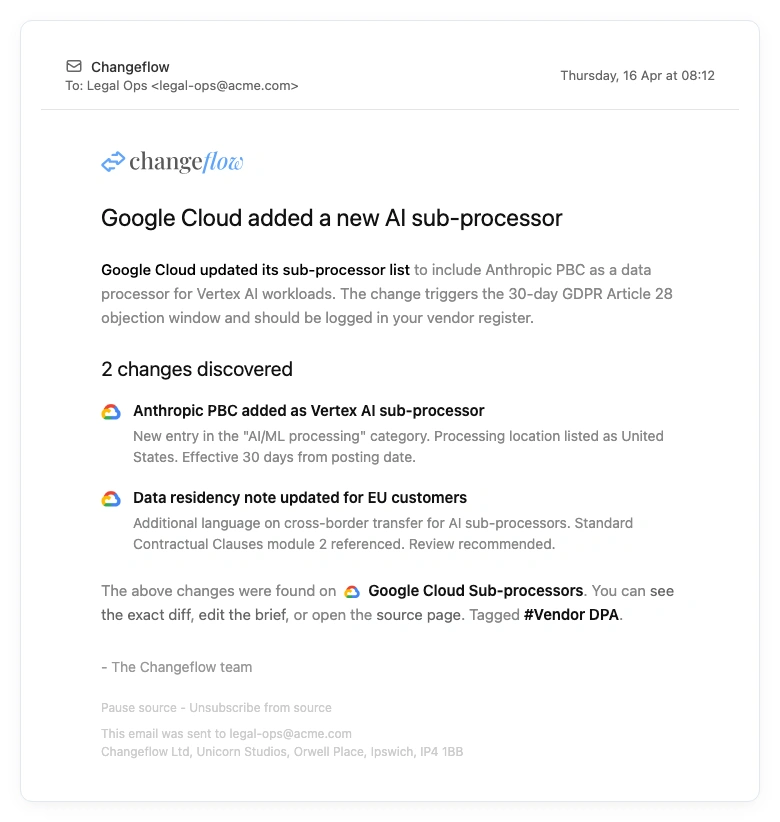
Here's the pattern. You point Changeflow at a vendor URL. You write a short brief: "track sub-processor additions, removed sub-processors, and processing location changes." The AI reads the page on your schedule, applies the brief, and only sends an alert when something in that brief moved. The Google Cloud sub-processor page gets checked weekly. You get an email the day a new AI sub-processor shows up. The rest of the time, silence.
Teams at Big 4 consultancies and Am Law 200 firms use this setup to keep their vendor stack mapped without adding another platform. It lives next to the CLM, not in place of it. The CLM owns the signed paper. Changeflow watches the public layer for drift, the same way our website alerts catch regulator pages.
The same pattern works for website monitoring in law firms, regulatory filings, or any page where the words matter more than the pixels.
Setup Checklist
A practical starter template for a legal ops team taking this on:
- Export your vendor register. Most CLMs can dump a CSV of active vendors with their MSA URLs. Sort by data sensitivity.
- Tier the list. 10-30 Tier 1, 50-150 Tier 2, everything else in Tier 3. Document the criteria.
- For Tier 1, find all 8 document URLs. TOS, PRIV, DPA, SUBP, AUP, SLA, SEC, PRICE. A vendor that hides their DPA behind "contact us" is a signal on its own.
- For Tier 2, find the 4 critical URLs. DPA, SUBP, PRIV, SEC.
- For Tier 3, find 2. SUBP and DPA.
- Set check cadence by document type. Sub-processors weekly. Privacy and TOS monthly. DPA and SLA quarterly. SEC monthly for certification drift.
- Define your brief per document type. Re-use the prompts above. Don't track "any change" or you will drown in cosmetic edits.
- Route alerts by role. DPA to privacy counsel. TOS to legal ops. SUBP to the vendor register owner. Pricing to procurement.
- Keep a compliance archive. When a DPA changes, keep the old version so you can diff against the version in force when you signed.
That is the whole system. The hard part is the tiering and the routing. The monitoring, once automated, takes almost no time.
How This Fits With CLM and TPRM
This is a common question. The short answer: vendor policy monitoring sits alongside your CLM and TPRM, it doesn't replace either.
- CLM (Ironclad, Agiloft, LinkSquares, DocuSign CLM) owns the signed paper. It tracks obligations in the contract you negotiated.
- TPRM (OneTrust, Prevalent, Venminder) runs the risk questionnaires, SOC 2 reviews, and annual assessments.
- Vendor policy monitoring catches the drift between what you signed and what the vendor is saying publicly right now.
All three talk to each other. A new sub-processor detected by monitoring triggers a TPRM review and, if material, a CLM amendment. A TOS drift between the signed MSA and the current public terms creates an enforceability question that your CLM alone can't see.
Most teams we talk to were doing the first two and silently not doing the third. The third is where most of the quiet risk lives.
Frequently Asked Questions
Do SaaS vendors have to notify customers when they change their terms?
In most B2B contracts, no. Vendors reserve the right to update their Terms of Service, Acceptable Use Policy, and public DPA at any time by posting a new version to their website. Continued use counts as acceptance. GDPR adds one narrow obligation, sub-processor changes on the public list. Everything else is silent by default.
How often do SaaS terms of service actually change?
Across the 200 most common B2B SaaS vendors, privacy policies change 2-4 times per year, Terms of Service change 1-2 times per year, DPAs change 1-2 times per year, and sub-processor lists change every few months. Pricing pages change 2-3 times per year. The cadence varies per vendor and per document type.
What counts as a material change in a DPA?
A material change in a Data Processing Agreement usually means one of: a new sub-processor, a removed Standard Contractual Clause, a change in breach notification timeline, a shift in data residency, a change in deletion SLA at termination, or an expansion in data processing scope. These can trigger contract re-signing or legal review.
Which vendor pages should a legal ops team watch?
At minimum: Terms of Service, Privacy Policy, Data Processing Agreement, Sub-processor list, Acceptable Use Policy, Service Level Agreement, and Security / Trust Center. For AI vendors also watch AI usage terms. For regulated industries add the enterprise pricing page and any product-specific addenda.
How is this different from a contract management system?
CLM platforms like Ironclad and Agiloft track contracts your team signed. They do not watch the public web pages vendors quietly update. A vendor can change their public DPA without touching your signed MSA. Monitoring the public layer is a separate job from CLM. Both matter.
Most legal ops teams discover this the way everyone else does. Someone catches a sub-processor change by accident, realizes it has been two months, and asks how many others they missed. The honest answer is usually: a lot. The good news is it takes an afternoon to fix the process.
Watch every vendor page, without reading every vendor page
Point Changeflow at a ToS, DPA, or sub-processor URL, describe what matters, and the AI reads it for you. Free to try.
Try Changeflow FreeNo credit card required
More from Learn

Wayback Machine for Legal Research: A Law Librarian's Guide
Half the URLs in old briefs are dead. Here is how law librarians use the Wayback Machine and stronger archives to verify citations, build timelines, and support litigation.

Law Librarian Current Awareness Audit Checklist (2026)
A 27-question audit covering coverage, cadence, relevance, distribution, resilience, and value. Built for law librarians and knowledge lawyers running current awareness at Am Law 200 firms.

Audit-Ready Web Archives: SEC 17a-4, FDA, and HIPAA Rules
Free archive tools fail under regulatory audit. Here is what SEC 17a-4, FDA 21 CFR Part 11, and HIPAA require from a web archive that holds up under examination.