
How to monitor SEC filings on EDGAR before they move markets. Set up alerts for 8-K, Form 4, and 13-D filings with AI filtering.

How to Monitor SEC Filings and EDGAR Alerts
On August 14, 2024, Berkshire Hathaway's 13-F filing revealed Warren Buffett had sold 56% of his Apple stake. The stock dropped 2% before most retail investors even knew the filing existed.
That's why you need to monitor SEC filings systematically. EDGAR processed 786,768 filings in 2022 alone, roughly 3,000 per business day, from over 158,000 filers. Material events, insider trades, activist positions, earnings restatements. They're all in there. But EDGAR is a database, not an alert system. If you're not watching the right pages at the right time, you find out from a Bloomberg headline instead of the source.
This matters for three reasons. Compliance officers need to catch disclosure obligations before deadlines pass. Investment analysts need material information as close to filing time as possible. Corporate counsel need to know when competitors, counterparties, or clients file something relevant.
This guide covers which SEC filing types to monitor, how EDGAR's built-in tools work, where they fall short, and how to build a monitoring system that catches what matters.
Why SEC Filing Monitoring Matters Now
The SEC filed 583 enforcement actions in fiscal year 2024, collecting $8.2 billion in penalties and disgorgement. That's the highest dollar figure in the agency's history.
A significant portion of those cases involved disclosure failures. In September 2024, the SEC ran a late filing enforcement sweep that charged 23 entities and individuals, collecting $3.8 million in penalties. Alphabet paid $750,000. Goldman Sachs paid $300,000. The SEC used data analytics to identify the late filers. And in August 2024, Carl Icahn paid $2 million to settle charges that he failed to timely amend Schedule 13D filings. Icahn Enterprises stock had already dropped 20% in a single day when the undisclosed margin loans were exposed.
The penalties aren't just for hedge fund billionaires. The SEC's Division of Enforcement estimated that investors were deprived of information on $90 million+ in company stock transactions due to late or missing filings. The enforcement trend is clear: the SEC expects timely, complete disclosure, and it's using data analytics to catch violators.
For compliance teams at public companies, compliance monitoring of SEC filings isn't optional. You need to know what your own company filed, what your competitors filed, and what the SEC's latest enforcement priorities look like. Miss any of those, and you're flying blind.
Monitor regulatory pages automatically
Changeflow watches agency websites and tells you what changed and why it matters.
Free plan available. No credit card required.
The Filing Types That Matter
Not all 787,000 annual EDGAR filings deserve attention. The top 20 form types account for 80% of volume. Here are the ones that compliance teams, analysts, and counsel actually need to track.
Form 8-K: Material Events
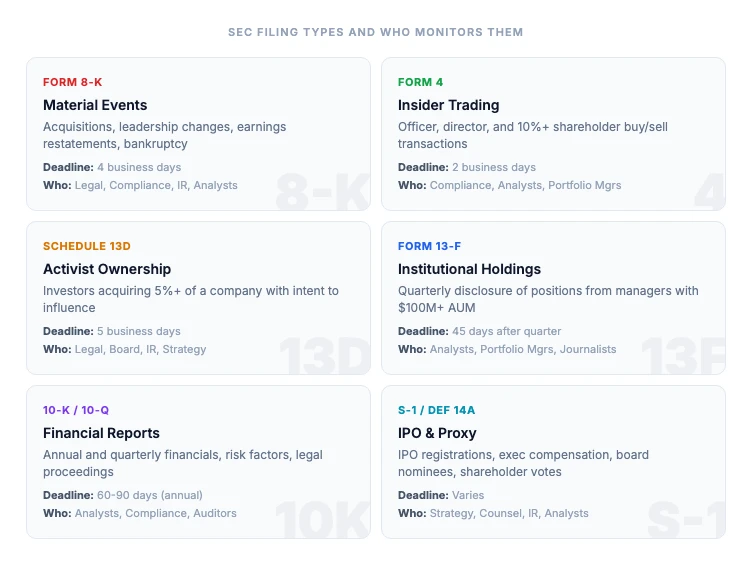
The 8-K is the SEC's real-time disclosure mechanism. Companies must file within 4 business days of a material event. These include:
- Bankruptcy or receivership
- Acquisitions or dispositions of assets
- Material impairments or restructuring charges
- Changes in leadership (CEO, CFO, board members)
- Amendments to articles of incorporation
- Earnings restatements
- Entry into material agreements
Research shows that 8-K filings generate measurable stock price movement within the first hour of publication. For investment analysts, catching an 8-K early can be the difference between an informed position and a late reaction.
Form 4: Insider Trading Reports
Officers, directors, and 10%+ shareholders must file Form 4 within 2 business days of any transaction in company securities. (SOX shortened this from 10 days after month-end.) This is the most filed form on EDGAR: 182,342 in 2022, representing 29% of all submissions.
Form 4 is one of the strongest legal signals in public markets. When a CEO buys $5 million worth of their own stock, that's worth knowing about. The 2-business-day deadline is strict. The SEC's 2024 enforcement sweep specifically targeted late Form 4 filers.
Schedule 13D/13G: Beneficial Ownership
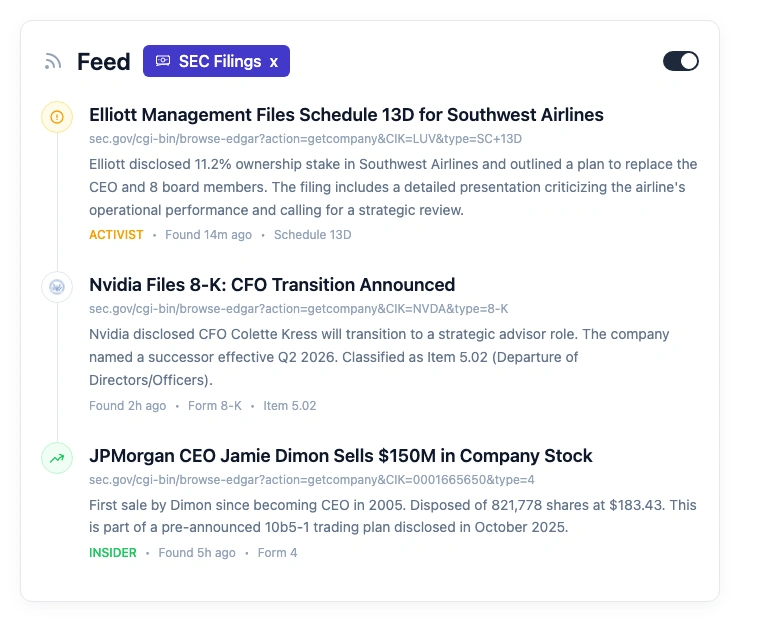
When an investor acquires more than 5% of a public company's shares, they must file Schedule 13D within 5 business days. (The SEC shortened this from 10 calendar days in October 2023, effective February 2024. Amendments are now due within 2 business days.) As SEC Chair Gensler put it: "In our fast-paced markets, it shouldn't take 10 days for the public to learn about an attempt to change or influence control of a public company."
Schedule 13D filings are among the highest-impact disclosures on EDGAR. When an activist investor like Elliott Management or Starboard Value files a 13D, the target company's stock often moves 5-10% within hours. Monitoring these filings is standard practice for regulatory intelligence teams at investment firms.
Form 13-F: Institutional Holdings
Every institutional investment manager with $100 million or more in qualifying assets must file Form 13-F quarterly, within 45 days of quarter end. These filings reveal what the largest investors in the market are buying, selling, and holding.
13-F filings are heavily analyzed by investment professionals, financial journalists, and competitive intelligence teams. Buffett's quarterly 13-F is a market event in itself. But there are over 5,000 institutional managers filing 13-F reports each quarter. Monitoring them manually is impossible.
Form 10-K/10-Q: Annual and Quarterly Reports
The workhorse filings. Every public company files a 10-K annually and 10-Q quarterly. These contain financial statements, risk factors, management discussion, and legal proceedings. Changes between filing periods, especially in risk factor language or legal contingency disclosures, signal developing issues.
Other Filing Types Worth Watching
- Form S-1: IPO registration statements. Critical for tracking new public companies and competitor capital raises.
- DEF 14A: Proxy statements. Reveal executive compensation, board nominees, and shareholder proposals.
- Form D: Regulation D exemption filings for private placements. Early signal of competitor fundraising.
- DEFA14A: Additional proxy soliciting materials. Often filed during proxy fights and activist campaigns.
EDGAR's Built-In Monitoring Tools
Before setting up external monitoring, know what EDGAR gives you for free.
Company-Specific RSS Feeds
EDGAR provides RSS feeds for individual company filings. You can subscribe to all filings for a specific CIK (central index key) number. This works well if you're tracking a known set of companies.
Limitations: You need to set up a separate feed for each company. There's no filtering by filing type within a feed. If a company files 50 routine amendments, you get 50 alerts with no way to distinguish them from a material 8-K.
Full-Text Search System (EFTS)
The SEC's full-text search system covers all filings submitted electronically since 2001. New filings are indexed and searchable within 60 seconds of publication. It supports Boolean operators, exact phrase matching, and filtering by company, CIK, or filing type.
Limitations: Search is keyword-based, not semantic. A search for "restructuring" returns every filing that contains the word, including boilerplate risk factors. The noise-to-signal ratio is high. And EFTS only covers the filings themselves, not SEC guidance pages, enforcement actions, or regulatory change management updates.
EDGAR Filing Index Pages
EDGAR maintains filing index pages that show the most recent submissions by filing type. You can bookmark the 8-K index, the Form 4 index, etc. But these pages show every filing across all companies, and the volume is overwhelming.
Where EDGAR Falls Short
The gap between what EDGAR provides and what teams actually need comes down to three things.
No Materiality Filtering
EDGAR treats every filing equally. A routine amendment to a previously filed document gets the same treatment as an 8-K announcing a CEO resignation. RSS feeds and EFTS alerts don't distinguish between the two.
Compliance and analyst teams need materiality filtering. They need to know "something important was just filed" not just "something was filed."
No Cross-Filing Context
When a company files an 8-K about a pending acquisition, and two weeks later the target company files its own 8-K, EDGAR doesn't connect them. When an activist files a 13D and then the target company files a DEFA14A responding to it, those are separate, unlinked filings.
Building context across related filings requires monitoring multiple companies and filing types simultaneously.
No Coverage Beyond Filings
The SEC publishes far more than just corporate filings. Enforcement actions, staff guidance, no-action letters, rule proposals, and commission speeches all appear on SEC.gov outside of EDGAR. A new SEC staff legal bulletin can change how companies interpret disclosure obligations. A proposed rulemaking can signal upcoming compliance requirements.
EDGAR RSS feeds and EFTS miss all of this. It's the "regulatory dark matter" problem: the most actionable information often lives outside the formal filing system.
How to Build a SEC Filing Monitoring System
Here's a practical setup that covers EDGAR filings and the SEC content that lives outside the filing system.
Step 1: Define Your Monitoring Universe
Start with three lists:
Companies to watch: Your own company (if public), direct competitors, key customers, counterparties, portfolio companies. For most compliance teams, this is 10-50 companies.
Filing types to track: For compliance officers, prioritize 8-K, Form 4, and annual/quarterly reports for your own company. For analysts, add 13-D/13-G, 13-F, and S-1 filings for your investment universe. For counsel, add proxy filings and enforcement actions for companies in your sector.
SEC pages beyond EDGAR: Division of Enforcement actions, Office of Compliance Inspections examination priorities, rule proposals, and staff guidance relevant to your industry.
Step 2: Set Up EDGAR RSS Feeds for Known Companies
For your core company watchlist, subscribe to EDGAR RSS feeds. Each feed covers all filing types for one CIK. Add these to your RSS reader or feed aggregator.
This gives you baseline coverage. When Apple files anything with the SEC, you'll see it. But you won't know if it matters.
Step 3: Add Filtered Monitoring for Key Filing Types
Use a website monitoring tool to track changes on specific EDGAR search result pages. With Changeflow, the setup is:
- Run an EDGAR search for the filing type you care about (e.g., all 8-K filings for a specific company, or all 13-D filings across the market)
- Save the search URL as a source
- Set a brief: "Alert me to new filings. Summarize what the filing discloses and whether it's material."
- Route website alerts to your compliance or analyst team
The AI reads the filing index, identifies new submissions, and tells you what they contain. This is the materiality filter that EDGAR doesn't provide.
Step 4: Monitor SEC.gov Beyond Filings
Set up change detection on SEC pages that publish enforcement and guidance content:
- Enforcement actions: The SEC's litigation releases page
- Staff guidance: Division of Corporation Finance staff bulletins
- Rule proposals: SEC rulemaking page
- Exam priorities: Office of Compliance Inspections
- Speeches: SEC commissioner speeches that signal policy direction
These pages change irregularly but carry significant compliance implications. A compliance officer who misses a new staff legal bulletin on climate disclosure, for example, may not update their company's reporting until it's too late. Horizon scanning for these non-filing changes is where automated monitoring adds the most value.
Step 5: Build Your Alert Workflow
Different stakeholders need different alerts:
| Filing Type | Who Needs It | Response Time |
|---|---|---|
| Form 8-K (own company) | Legal, compliance, IR | Immediate |
| Form 8-K (competitors) | Strategy, competitive intel | Same day |
| Form 4 (insider trades) | Compliance, analysts | Same day |
| Schedule 13D (activist) | Legal, board, IR | Immediate |
| 13-F (institutional) | Analysts, portfolio managers | Weekly review |
| Enforcement actions | Compliance, legal | Same day |
| Rule proposals | Compliance, legal | Weekly review |
Most teams route critical alerts (8-K, 13D) to Slack or email with immediate notification, and batch less urgent items (13-F, rule proposals) into a weekly digest.
What SEC Filing Monitoring Costs
The range is wide.
Free tier: EDGAR RSS feeds + EFTS email alerts + Google Alerts. Covers basic filing notifications but no filtering, no context, no SEC.gov content outside EDGAR.
Mid-range ($99-200/month): Website monitoring tools like Changeflow that watch EDGAR pages and SEC.gov content. AI filtering separates material from routine. Covers both filings and non-filing SEC content.
Enterprise ($5,000-25,000+/year): Bloomberg Terminal, Intelligize, S&P Capital IQ. Real-time filing alerts, full-text search across historical filings, analytical tools, financial data integration. These are institutional-grade platforms for teams that need everything.
Regulatory intelligence ($50,000-200,000+/year): Platforms like FiscalNote and Thomson Reuters Regulatory Intelligence that cover SEC plus other regulators. Include obligation mapping, workflow management, and audit trails.
For most compliance teams at public companies, the mid-range option covers the awareness layer. You know what was filed and why it matters. If you need deep financial analysis of filing content, the enterprise platforms earn their price. The two approaches aren't mutually exclusive. Many teams use Changeflow for broad SEC.gov monitoring and Bloomberg or Intelligize for filing-specific analysis.
Common Mistakes
Monitoring Only Your Own Company
Your company's filings are just the starting point. Competitor 8-Ks reveal strategic moves. Customer 10-K risk factors flag potential churn. Counterparty filings signal credit risk. The SEC ecosystem is a competitor tracking goldmine if you monitor beyond your own CIK.
Ignoring Non-Filing SEC Content
Rule proposals, staff guidance, and enforcement actions affect your compliance obligations as much as any filing. A new SEC interpretive release on cybersecurity disclosure can change what belongs in your next 10-K risk factors section. Monitor SEC.gov, not just EDGAR. And if you're tracking the SEC, you should also monitor federal agency websites at the OCC, CFPB, and other regulators that affect your business.
Relying Solely on Financial Data Terminals
Bloomberg and Capital IQ are excellent for financial data and filing search. But they don't monitor SEC guidance pages, enforcement trends, or rulemaking activity. Teams that rely solely on terminals miss the regulatory intelligence that shapes future compliance requirements.
No Response Process for Material Filings
Detection without a response process is useless. When a 13D filing hits for your company at 4:47 PM on a Friday, who gets notified? What's the escalation path? How quickly can your IR team prepare a statement? Build the workflow before you need it.
Missing Form 4 Clusters
A single Form 4 filing might mean nothing. But when five insiders sell within the same week, that's a pattern. Monitoring individual filings without looking for clusters misses the most useful signal that insider trading data provides.
Industries That Need SEC Filing Monitoring
Financial Services
Banks, broker-dealers, and asset managers face overlapping requirements from the SEC, FINRA, OCC, CFPB, and state regulators. SEC enforcement actions against competitors signal where examiners will focus next. Regulatory compliance examples in financial services almost always involve SEC disclosure requirements. Tracking SEC, OCC, CFPB, and FINRA pages directly (through automated page monitoring or each agency's email lists) gives compliance teams a baseline awareness layer across agencies.
Legal
Corporate law firms monitor SEC filings for client matters, M&A due diligence, and litigation signals. An 8-K disclosing a material legal proceeding can trigger client notification obligations. Website monitoring for law firms increasingly includes SEC filing tracking as standard practice.
Healthcare and Pharma
Publicly traded pharma companies file 8-Ks for FDA approvals, clinical trial results, and material agreements. Monitoring competitor filings reveals pipeline progress before press releases. Teams already doing FDA and CMS monitoring benefit from adding SEC coverage for the financial side of healthcare compliance.
Getting Started
If you're setting up SEC filing monitoring for the first time:
- List your top 10 companies to watch (own company + competitors + key counterparties)
- Set up EDGAR RSS feeds for each one
- Add Changeflow monitoring on EDGAR search results pages for key filing types (8-K, 13D, Form 4)
- Monitor 2-3 SEC.gov pages beyond EDGAR (enforcement, guidance, rulemaking)
- Route alerts to the right people with clear response expectations
You can set up the basics in under an hour. The companies that catch SEC filings first don't have bigger teams or better analysts. They just built a system that doesn't depend on someone remembering to check EDGAR.
That's the difference between reading about a material filing in tomorrow's Wall Street Journal and reading the filing itself 10 minutes after it hits EDGAR.
Monitor SEC filings and EDGAR pages automatically
Get alerts when new filings appear, pages change, or disclosure deadlines pass. AI reads the content and tells you what matters.
Try Changeflow FreeNo credit card required
More from Learn

Wayback Machine for Legal Research: A Law Librarian's Guide
Half the URLs in old briefs are dead. Here is how law librarians use the Wayback Machine and stronger archives to verify citations, build timelines, and support litigation.

Law Librarian Current Awareness Audit Checklist (2026)
A 27-question audit covering coverage, cadence, relevance, distribution, resilience, and value. Built for law librarians and knowledge lawyers running current awareness at Am Law 200 firms.

Audit-Ready Web Archives: SEC 17a-4, FDA, and HIPAA Rules
Free archive tools fail under regulatory audit. Here is what SEC 17a-4, FDA 21 CFR Part 11, and HIPAA require from a web archive that holds up under examination.