
We tried to find out what the 15 biggest regulatory intelligence and current awareness platforms cost in 2026. Here is what is public, what is hidden, and the sourcing behind every number.

Regulatory Intelligence Software: What It Actually Costs
If you have ever tried to budget for regulatory intelligence software, you already know the game. You ask for pricing. Sales sends a Calendly link. Ninety minutes of discovery later, you get a proposal with no comparable benchmark. You have no way to tell whether the number is fair, generous, or insulting.
We spent a working day trying to pull public numbers for every serious player in the category. The results were bleak, and instructive. A handful of vendors publish real prices. Most hide everything behind a demo request. One publishes a full rate card that embarrasses the rest.
This is the map. Fifteen regulatory intelligence and current awareness platforms law firms and compliance teams actually buy. What is public. What is estimated from SEC filings, procurement records, and sourced industry reporting. And what is genuinely unknowable without a sales call.
If you came here to compare a vendor quote against market rates, the summary table below is the fastest way in. If you are trying to understand why this market is this opaque in the first place, skip to the structural analysis near the end.
This sits alongside our guide to the law librarian current awareness workflow, which explains why a firm ends up buying six of these tools at once.
The Summary: What We Could Verify
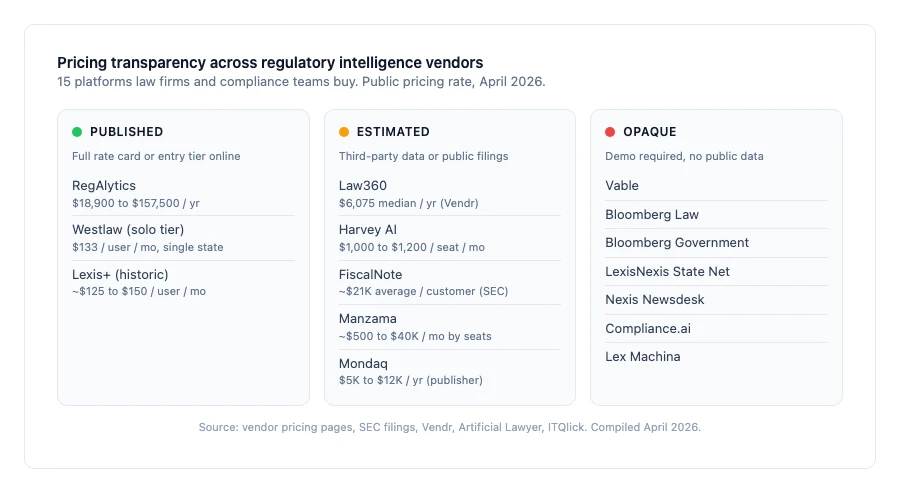
Three vendors publish enough pricing detail to plan a budget. Three more have enough third-party sourcing to give a responsible estimate. The rest are genuinely opaque at the time of writing.
| Vendor | Category | Pricing Transparency | Best Public Data Point |
|---|---|---|---|
| RegAlytics | Regulatory data | Public full rate card | $18,900 per seat per year to $157,500 enterprise |
| Westlaw Precision | Legal research | Partial (solo tier) | $133 per user per month, single state |
| Lexis+ AI | Legal research | Partial (historic) | Approx. $125 to $150 per user per month (2019 tier) |
| Law360 | Legal news | Third-party aggregate | Median $6,075 per year; range to $11,872 |
| FiscalNote | Policy and legislative | Implied from SEC filings | ARR $84.1M / 4,000+ customers = approx. $21K average |
| Harvey AI | Legal AI | Third-party estimate | $1,000 to $1,200 per seat per month, 20-seat minimum |
| Manzama | Current awareness | Third-party estimate | $500 per month solo; $25K to $40K at 100 seats |
| Mondaq | Legal content syndication | Partial (publisher side) | $5,000 to $12,000+ per year for law firms to publish |
| Vable | Current awareness | Opaque | Enterprise quote only |
| Bloomberg Law | Legal research | Opaque | Enterprise quote only |
| Bloomberg Government | Policy | Opaque | Enterprise quote only |
| LexisNexis State Net | Legislative | Opaque | Enterprise quote only |
| Nexis Newsdesk | News monitoring | Opaque | Enterprise quote only |
| Compliance.ai | Regulatory change | Opaque | Enterprise quote only |
| Lex Machina | Litigation analytics | Opaque | Custom pricing only |
| Docket Alarm | Court dockets | Partially public | Entry tiers referenced; firm tier opaque |
Everything below walks through each vendor in turn and shows the sourcing behind every number.
Track competitor prices on any website
Changeflow monitors pricing pages and tells you exactly what changed. Set it up in 30 seconds.
Free plan available. No credit card required.
The Legal Research Tier
Westlaw Precision (Thomson Reuters)
Westlaw is the largest single line item in almost any Am Law firm's research budget. Thomson Reuters publishes its low-end solo pricing through reseller partners and library cost guides. Beyond that, the pricing is custom.
- Westlaw Classic, one state, one year commitment: roughly $132.80 per user per month.
- Westlaw Classic, all states: starts at $200 per user per month.
- Westlaw Classic, all states plus federal: starts at $266.40 per user per month.
- Westlaw Edge (AI-enhanced): starts at $194.40 per user per month for a single state.
Source: Franklin County Law Library's cost-effective research guide, which tracks published Thomson Reuters reseller rates. Firm pricing for seven-plus attorneys is bundled, discounted, and negotiated. A 500-attorney Am Law firm is not paying list. Realistic per-seat rates inside a large firm fall considerably below the solo list price, but total contract values run into the low seven figures.
Lexis+ AI (LexisNexis)
Co-dominant with Westlaw. Historical pricing from a 2019 LawSites comparison by Bob Ambrogi put the Lexis Advance Enhanced plan at roughly $125 per user per month on a three-year deal, or $148.84 per user per month for a one-year deal. That data is six years out of date, but LexisNexis pricing has not become more transparent since. Expect large-firm pricing to be negotiated, bundled with Law360 or Lex Machina, and not publicly quotable.
Bloomberg Law
Fully opaque. Every pricing page redirects to a sales contact form. Third-party aggregators do not have enough signal to publish a meaningful range. Anecdotally, it tracks below Westlaw and Lexis for the core platform but scales into six figures with added practice center subscriptions.
CoCounsel (Thomson Reuters)
Launched inside Westlaw Precision in 2023, expanded with agentic workflows in early 2026. Thomson Reuters does not publish separate CoCounsel pricing for firms on Westlaw Precision. For Am Law buyers, CoCounsel is effectively an upsell on top of an existing Westlaw contract. For corporate legal and smaller firms, standalone CoCounsel starts at custom enterprise pricing.
Harvey AI
The most-watched premium line item in the legal AI stack. Harvey has never confirmed public pricing, but three independent industry sources (eesel AI, Artificial Lawyer, irys.ai) have converged on the same range:
- Per seat: $1,000 to $1,200 per lawyer per month.
- Minimum seats: 20 in most reports; some legal ops buyers on Reddit cite 25 to 50.
- Contract length: 12 months minimum.
- Implied annual floor: approximately $288,000.
That is a first-year commitment of a third of a million dollars before you budget implementation, training, or the LexisNexis data layer Harvey plugged into in mid-2025. Harvey's partners are Allen & Overy, PwC, and other Am Law 100 and Fortune 500 buyers. The pricing is built around that buyer.
The Current Awareness Tier
This is the tier most law librarians interact with daily. It is also the second most opaque, after policy intelligence.
Manzama (Diligent)
Acquired by Diligent in 2019. Nearly 40 of the top 100 US law firms use it, including 8 of the top 10. Pricing is custom. Third-party resource ITQlick reconstructs the range from client data:
- Basic single user: approximately $500 per month.
- 10-user deployment: approximately $3,000 to $5,000 per month.
- 100-user deployment: approximately $25,000 to $40,000 per month (roughly $300,000 to $480,000 per year).
Those numbers are not Diligent-confirmed. Treat them as directional. The ITQlick figures line up reasonably with what large-firm librarians mention in private conversation.
Vable
Used by Reed Smith, Watson Farley & Williams, and Williams Mullen. Pricing is not published and third-party aggregators have not collected enough buyer signal to reconstruct a range. Enterprise quote only.
Nexis Newsdesk (LexisNexis)
Media monitoring with copyright-compliant distribution. Bundled in most Am Law Lexis contracts. Standalone pricing is enterprise-only and not publicly quoted.
Law360 (LexisNexis)
The one data point with independent sourcing. Vendr, a B2B SaaS procurement platform that tracks deal data across its buyer network, reports:
- Median Law360 contract: $6,075 per year.
- Range: $6,075 to $11,872 per year.
Those are small-team or multi-seat contract values rather than per-seat costs. Firm-wide Am Law deployments run into six figures. A notable quirk: Law360 aggressively enforces its licensing terms, which creates the well-known frustration inside law libraries about forwarding articles.
Mondaq
The one inverted model in the category. Readers pay nothing. Law firms pay to syndicate their content into Mondaq's platform. Published firm-side rates run $5,000 to $12,000+ per year depending on article volume and firm size. As a reader, Mondaq is free. As a publisher, it is a content distribution line item.
The Policy and Legislative Tier
FiscalNote and PolicyNote
FiscalNote is the only name in this section with real SEC-level financial disclosure, because it went public via SPAC in 2022. It has since gone private again (announced 2024), but the public filings remain a rare window into pricing economics in this market.
From the FY2024 and FY2025 financials:
- 2024 revenue: $120.3 million
- 2025 revenue: $95.4 million (reflects divestitures)
- 2025 ARR: $84.1 million
- Customer count: 4,000+
- Net revenue retention: approximately 96%
- Subscription revenue share: 93%
Divide ARR by customer count and you get an average of roughly $21,000 per customer per year. That average hides enormous variance. Government agency and enterprise contracts run well into six figures. PolicyNote's "Platform Only" self-serve tier likely sits in the low four figures. The range inside one customer book is probably 100x from smallest to largest.
PolicyNote itself publishes three tiers (Platform Only, Essential, Advanced) but no dollar amounts. Essential adds a dedicated policy analyst. Advanced adds weekly executive briefs. All three require a demo.
LexisNexis State Net
Legislative and regulatory tracking across 150,000+ legislative measures and 50,000+ regulatory measures. Opaque. Bundled in many Lexis+ Am Law contracts. Standalone firm pricing not published.
Bloomberg Government (BGOV)
Federal policy, legislative, and regulatory intelligence. Opaque. Standalone pricing enterprise-only.
The Regulatory Change Tier
RegAlytics
The transparency outlier. RegAlytics publishes every tier on its public pricing page, and the numbers are specific enough to budget from today:
- Essentials (freemium): $49.99 per month; 90-day alert history; no API.
- Single Seat (annual): $18,900 per year.
- Team (8 licenses, annual): $37,800 per year.
- Unlimited licenses (annual): $60,480 per year.
- Enterprise with API (annual): $107,100 per year.
- White-label Enterprise (annual): $157,500 per year.
Add-ons are also public: $500 per extra license, $25 per URL onboarding request, $500 per Chatbot user for beta access. This is what pricing transparency looks like in this market. It is unusual enough to be worth pointing out. Every other vendor on this list could publish something similar and chooses not to.
Compliance.ai
Opaque. Third-party commentary benchmarks it against similar regtech platforms. Regology's comparable Professional tier is public at $1,700 per user per month on a three-year contract, which implies Compliance.ai likely sits in a similar range. Expect $15,000 to $25,000 per user per year on multi-year contracts for mid-market buyers, scaling by jurisdiction coverage.
The Litigation Analytics Tier
Lex Machina (LexisNexis)
Pricing starts at roughly $300 per year according to some third-party aggregators, which is almost certainly only an entry-level data point rather than typical firm pricing. Firm-tier Lex Machina bundled with Lexis+ is custom and not published.
Docket Alarm (vLex)
Tiered pricing is referenced in third-party comparisons as "more transparent" than Lex Machina, but specific firm-tier numbers are not publicly available. For solo and small-firm buyers, entry points exist. Am Law firm pricing is bundled into vLex agreements.
Why This Market Is This Opaque
Six reasons, in rough order of importance.
1. Price discrimination. Every vendor in this category negotiates by firm headcount, practice groups covered, jurisdictions, seats, and contract length. Published pricing would become the ceiling instead of a negotiation starting point. The incumbent math is clear: hiding pricing lets them charge a 20-attorney boutique differently from Kirkland. Publishing pricing forces a single rate.
2. Bundling. Westlaw bundles Practical Law, CoCounsel, and sometimes Law360. Lexis+ bundles Lex Machina and Nexis Newsdesk. Bloomberg Law bundles BGov adjacent products. Standalone pricing creates a benchmark that makes unbundled purchases look overpriced, so the incumbents refuse to publish it.
3. Procurement compliance makes this worse. Most large law firms push these procurements through a formal RFP process. Vendors know the buyer cannot easily compare against other buyers. The "most favored customer" pricing promise that exists in government procurement (via GSA) does not exist in the law firm market.
4. Sales-led culture. These products evolved out of the Thomson, LexisNexis, and Bloomberg publishing empires. Print subscription pricing was always negotiated. Digital platforms inherited the culture and never switched.
5. Switching costs are massive. A firm on Westlaw has KeyCite integrated into every brief template. Switching to Lexis is a year-long migration. High switching costs support opaque pricing because buyers cannot credibly walk away.
6. No category-wide benchmark service. Vendr publishes some data. G2 publishes review signals but not pricing. Gartner Peer Insights is focused elsewhere. No pricing transparency aggregator has critical mass in legal research and regulatory intelligence.
The Gap Everyone Is Paying to Miss
Look back at that stack. Every vendor on it monitors something that has already been published: case law, statutes, legislative texts, press releases, news articles, practice guides.
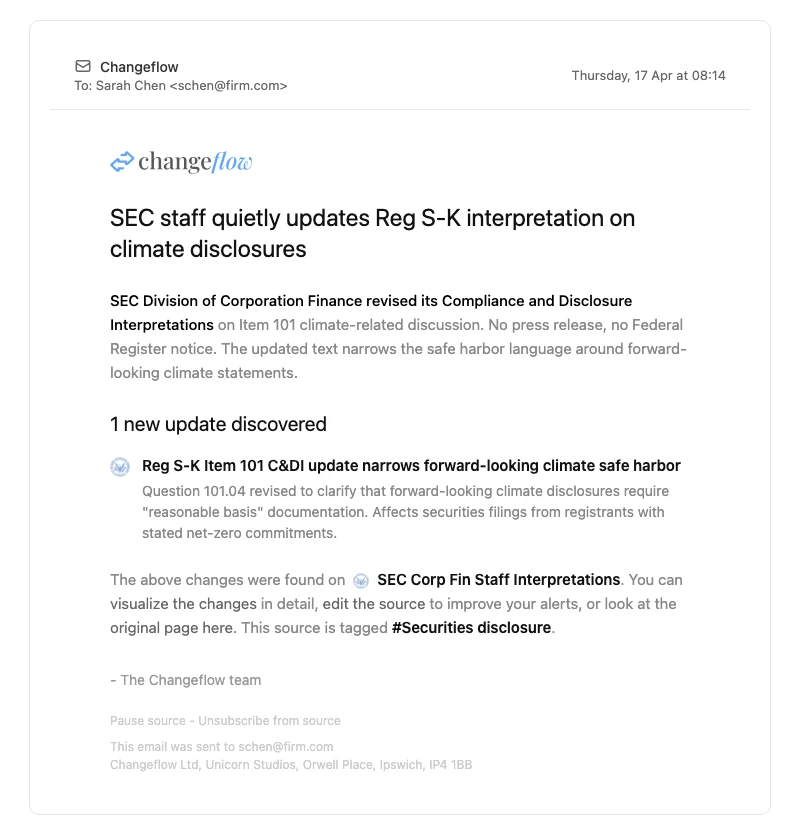
None of them watch the quiet layer underneath. Agency guidance pages that get edited without fanfare. FDA warning letter pages that add a new entry. SEC staff interpretations that get revised. State attorney general "know your rights" pages. Agency FAQs. Enforcement dashboards. Policy sub-pages that change a paragraph and never issue a press release.
This is the regulatory dark matter that a compliance officer or litigation partner actually needs to know about. It is a smaller share of published regulatory volume and a much larger share of the questions they actually get asked. And it is a gap the incumbents have left alone for twenty years.
Changeflow watches those pages. You point it at an agency URL, you describe what matters in plain English, and it reads the page for you. The price is transparent. The source of every alert is the agency page itself, not a filtered feed with licensing restrictions.
The opacity elsewhere in this stack exists for a reason. We do not think that reason applies anymore.
Bottom Line
- Three vendors publish real prices: RegAlytics (full rate card), Westlaw (solo tier), Lexis+ (historic solo tier).
- Three have enough third-party data to budget: Law360 (Vendr), Harvey AI (industry convergence), FiscalNote (SEC filings).
- Nine are genuinely opaque: Bloomberg Law, Bloomberg Government, Vable, Manzama (custom), LexisNexis State Net, Nexis Newsdesk, Compliance.ai, Lex Machina, Docket Alarm.
- The category is structured to keep it this way through price discrimination, bundling, and procurement friction.
If you are trying to compare a vendor quote against market data, send it to a peer firm's legal ops team. Published benchmarks are not going to appear unless the buyer side starts refusing to sign without them. And that fight tends to lose to the fact that, for most firms, walking away from Westlaw or Lexis is not actually an option.
For compliance officers and law librarians running current awareness programs, the practical move is to build a stack that covers the big three research platforms, one current awareness layer, and one policy tracker, then plug the agency-page gap directly. That last piece does not need to cost five figures.
See what the opaque tier is hiding
Changeflow watches the agency and vendor pages the incumbents ignore. Pricing is public. Cancel anytime.
Try Changeflow FreeNo credit card required
More from Learn

Wayback Machine for Legal Research: A Law Librarian's Guide
Half the URLs in old briefs are dead. Here is how law librarians use the Wayback Machine and stronger archives to verify citations, build timelines, and support litigation.

Law Librarian Current Awareness Audit Checklist (2026)
A 27-question audit covering coverage, cadence, relevance, distribution, resilience, and value. Built for law librarians and knowledge lawyers running current awareness at Am Law 200 firms.

Audit-Ready Web Archives: SEC 17a-4, FDA, and HIPAA Rules
Free archive tools fail under regulatory audit. Here is what SEC 17a-4, FDA 21 CFR Part 11, and HIPAA require from a web archive that holds up under examination.