
Government websites change constantly, and most compliance tools miss it. Here's how to monitor .gov pages for regulatory updates, policy shifts, and removed content.

Track Government Website Changes
The FDA quietly updated its enforcement guidance on a Tuesday afternoon. No Federal Register notice. No press release. Just a revised PDF on a subpage three clicks deep. A compliance officer at a pharmaceutical company found it six weeks later, during a routine manual check. By then, three product labels were out of compliance.
This happens constantly. Government websites are where regulatory reality lives, and most of it changes without any formal announcement. If your compliance workflow starts and ends with the Federal Register, you're missing most of the picture.
This guide covers what actually changes on government websites, which agencies matter most, what tools exist (free and paid), and how to build a monitoring system that catches changes before they become problems. If you're responsible for regulatory change management at any level, this is the infrastructure you need.
Why Government Websites Change More Than You Think
The Federal Register published roughly 71,000 documents in 2025. That sounds like a lot. But it's a fraction of what happens on government websites.
Federal agencies maintain hundreds of thousands of web pages. These pages contain guidance documents, FAQ updates, enforcement bulletins, policy interpretations, compliance manuals, forms, fee schedules, and staff letters. When an agency changes its position on how a rule should be applied, it often updates a guidance page instead of issuing a formal rule.
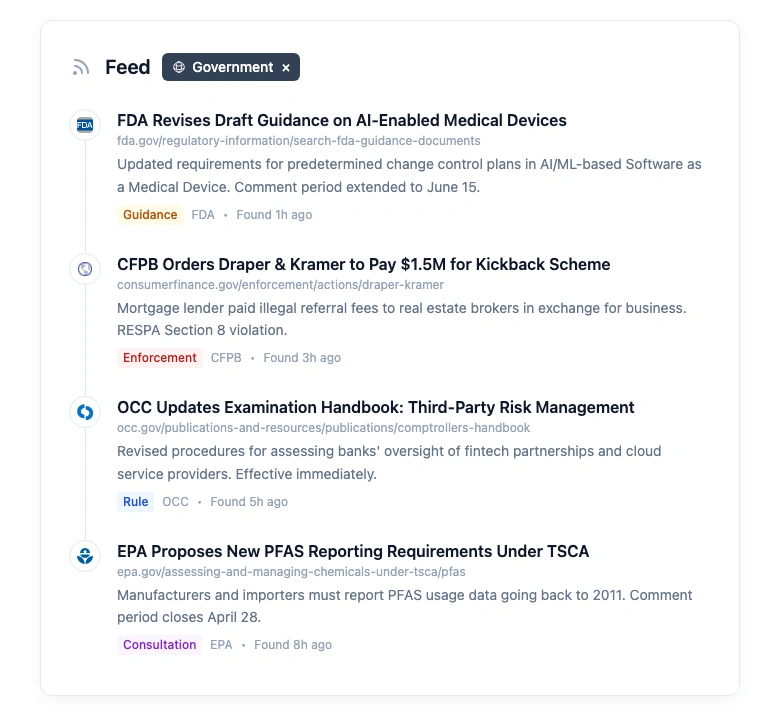
This is what some call "regulatory dark matter." The changes that affect your day-to-day compliance obligations but never show up in the official rulemaking process. An SEC staff bulletin on crypto custody. An FDA draft guidance on AI in medical devices. An OCC update to its examination handbook. An EPA revision to its enforcement response policy.
Each of these happened on a website. None of them required a Federal Register notice.
And then there's the political dimension. Since January 2025, more than 8,000 federal web pages have been removed or substantially modified, according to tracking by the EDGI and Sunlight Foundation. CDC alone saw thousands of pages altered. Entire datasets disappeared from agency sites. For compliance teams, journalists, researchers, and civic organizations, knowing what changed (and when) isn't optional.
Monitor regulatory pages automatically
Changeflow watches agency websites and tells you what changed and why it matters.
Free plan available. No credit card required.
What Changes and Where It Matters
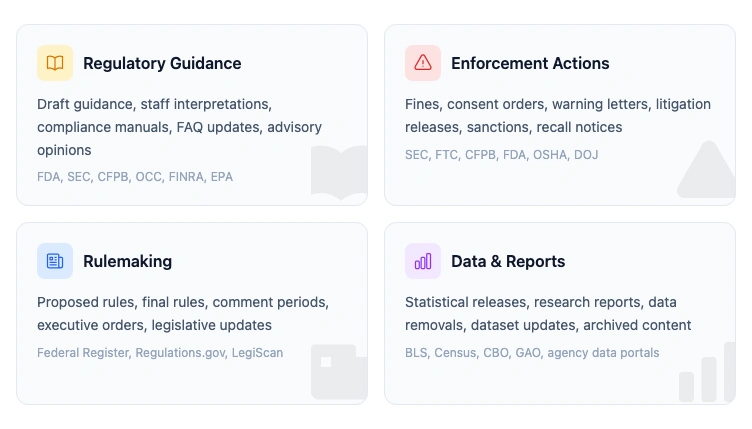
Not all government website changes are equal. Here's what to watch for, organized by the type of change.
Guidance documents are the big one. These aren't legally binding in theory, but in practice they define how agencies enforce their rules. When the CFPB updates its examination manual or the FDA revises a guidance on clinical trials, regulated entities need to know immediately. Most compliance monitoring software misses these because they focus on formal rules.
Enforcement actions and decisions appear on agency websites before they appear in legal databases. SEC enforcement releases, CFPB consent orders, FTC complaints, FDA warning letters. Being early on these means being early on trends. If you see the SEC filing three enforcement actions on crypto staking in a month, that's a signal even if no new rule exists.
Policy changes and interpretations often show up as revised FAQ pages, updated staff letters, or amended compliance bulletins. These are the changes that compliance teams need for maintaining regulatory compliance but are hardest to catch because they look like routine page updates.
Data removals and page restructures matter for transparency and research. When an agency removes a dataset, restructures its site, or archives content that was previously current, it affects anyone who relied on that information. Website archiving for compliance becomes essential.
Fee schedules and forms change on government websites without much fanfare. Filing fees, application forms, reporting templates. Miss a form update and your next filing gets rejected.
Key Federal Agencies to Monitor
Where you focus depends on your industry. Here are the highest-value agencies organized by sector.
Financial Services
The SEC publishes enforcement actions, staff guidance, no-action letters, and interpretive releases on its website constantly. Monitoring SEC filings and EDGAR covers one dimension, but the SEC's website contains much more than what appears in EDGAR.
The CFPB publishes supervision and examination manuals, enforcement actions, and consumer complaint data. Its guidance documents directly shape how banks and lenders operate. The OCC examination handbook drives how national banks are supervised. FINRA posts regulatory notices, disciplinary actions, and guidance that applies to every broker-dealer.
Healthcare and Pharmaceuticals
The FDA is one of the most change-heavy agencies. Drug approvals, warning letters, guidance documents, recalls, and safety communications all appear on fda.gov before anywhere else. CMS updates Medicare and Medicaid policies, coverage decisions, and fee schedules. HHS publishes HIPAA guidance and enforcement actions.
Legal and Compliance
For legal professionals, government websites are primary research sources. Court website monitoring covers the judicial side. On the regulatory side, virtually every state has an attorney general, insurance commissioner, banking regulator, and environmental agency publishing content that affects compliance requirements. See regulatory compliance examples for industry-specific patterns.
Environment and Energy
The EPA publishes enforcement actions, permitting guidance, and compliance advisories. The DOE posts energy regulatory updates and grid reliability standards. State environmental agencies (often called DEQs or DEPs) publish their own enforcement and guidance.
Free Tools for Government Website Monitoring
Before paying for anything, here's what works at zero cost. The honest caveat: free tools cover formal rulemaking and basic page-diff monitoring. They don't filter, summarize, or route by role. For most compliance teams, free is a starting layer, not a full solution.
Federal Register Email Subscriptions
The Federal Register offers free email subscriptions by agency, topic, or document type. You can subscribe to all proposed rules from the SEC, all final rules from the EPA, or all presidential documents. This covers formal rulemaking well but misses everything that happens outside the Federal Register process.
USA.gov RSS Feeds
USA.gov publishes RSS feeds for several categories of government content. Agency news, policy updates, and service changes. Not as granular as monitoring individual agency pages, but a decent starting layer.
Regulations.gov
For proposed rules that accept public comments, Regulations.gov lets you search and subscribe to specific dockets. If you need to track comment periods for rules in your industry, this is the authoritative source.
Wayback Machine
The Internet Archive's Wayback Machine captures snapshots of government websites over time. It's not a monitoring tool (it doesn't alert you to changes), but it's invaluable for seeing what a page looked like before a change. For compliance teams that need to prove what guidance was in effect on a specific date, this is essential evidence.
Paid Tools for Government Website Monitoring
When free tools aren't enough, these fill the gaps.
Changeflow
Changeflow lets you track any website by URL. Point it at a specific agency page, describe in plain English what you care about, and the AI reads the page on a schedule and sends alerts when relevant content appears.
Useful for: monitoring specific state regulatory pages, niche federal agency content, FDA guidance subpages, OCC examination handbooks, or internal government portals that broader tools miss. From $99/month.
Visualping
Visualping offers visual and text-based change detection for any web page. It's a general-purpose tool, not regulatory-specific. You won't get annotated feeds or role-based filtering, but it works for monitoring individual .gov URLs. Plans start at $10/month.
FiscalNote / CQ
Enterprise regulatory intelligence platforms that track legislation, regulations, and government activity. Starting at roughly $50,000/year. If you're a Fortune 500 compliance team, this might be in your budget. For everyone else, Changeflow covers most of the same agency-page ground at a fraction of the cost.
changedetection.io
Free, self-hosted, open-source. Monitors any URL for changes and sends notifications. Requires running a Docker container on your own server. No AI filtering, no annotation, no feeds. But it works, it's free, and you own the data. Good for technical teams who want full control.
Government Pages Worth Monitoring (By Category)
Most guides stop at "monitor government websites" and leave you to figure out which ones. Here are specific, high-value pages organized by function.
Regulatory Guidance
- FDA Guidance Documents: fda.gov/regulatory-information/search-fda-guidance-documents
- SEC Staff Guidance: sec.gov/regulation/staff-interpretations
- CFPB Supervisory Guidance: consumerfinance.gov/compliance/supervisory-guidance/
- OCC Bulletins: occ.gov/news-issuances/bulletins/
- FINRA Regulatory Notices: finra.org/rules-guidance/notices
- EPA Compliance Guidance: epa.gov/compliance/guidance
Enforcement Actions
- SEC Litigation Releases: sec.gov/litigation/litreleases
- CFPB Enforcement Actions: consumerfinance.gov/enforcement/actions/
- FTC Cases and Proceedings: ftc.gov/legal-library/browse/cases-proceedings
- FDA Warning Letters: fda.gov/inspections-compliance-enforcement-and-criminal-investigations/compliance-actions-and-activities/warning-letters
- OSHA Citations: osha.gov/citations
Rulemaking
- Federal Register Today: federalregister.gov/documents/search (filter by document type)
- Regulations.gov Open for Comment: regulations.gov (filter by "Open for Comment")
- State Bill Trackers: legiscan.com for multi-state coverage
Data and Reports
- BLS Economic Data: bls.gov/data/
- Census Bureau: census.gov/data.html
- CBO Reports: cbo.gov/about/products
- GAO Reports: gao.gov/reports-testimonies
Building a Government Monitoring System
Having tools isn't enough. You need a workflow.
Layer 1: Formal rulemaking. Subscribe to Federal Register email alerts for your key agencies. Add Regulations.gov alerts for dockets in your industry. This covers proposed rules, final rules, and comment periods. Free, but high noise unless you filter aggressively.
Layer 2: Agency-page monitoring. This is where most regulatory dark matter lives. Use Changeflow to track the specific agency pages that matter to your organization: FDA guidance documents, SEC staff bulletins, CFPB supervisory guidance, state regulator pages. The AI reads each page on a schedule and tells you what changed in plain English.
Layer 3: Industry-specific feeds. Layer in trade-association alerts and law-firm client alerts for your sector. These add interpretation and context that raw agency feeds don't provide.
Layer 4: Archive and evidence. For pages where you need to prove what the content said on a specific date, set up archiving. The Wayback Machine captures historical snapshots. Changeflow stores page history with timestamps for tracked sources.
Route by audience. Compliance officers need guidance changes and enforcement trends. Law librarians running current awareness route by practice group, so a pharma-practice partner doesn't receive SEC enforcement alerts. Legal teams need enforcement actions and court orders. Government affairs teams need proposed rules and comment periods. Researchers need data updates and report publications. Set up separate feeds or email filters for each audience.
Review cadence. Daily for enforcement actions and guidance changes. Weekly for rulemaking status. Monthly for trends and patterns. A digest feed makes this manageable without checking dozens of sites manually.
The Regulatory Dark Matter Problem
Here's the core issue with most compliance monitoring approaches: they focus on formal rules and miss everything else.
Legal research platforms like Westlaw and Bloomberg Law index statutes, regulations, and case law. They're excellent at what they do. But they don't monitor the thousands of agency web pages where practical compliance guidance actually lives.
Enterprise regulatory intelligence platforms like FiscalNote and Wolters Kluwer track legislation and formal rulemaking. Good for knowing what Congress and state legislatures are doing. But an FDA draft guidance posted on fda.gov? A CFPB blog post signaling enforcement priorities? An OCC FAQ that changes how examiners interpret an existing rule? Those live on agency websites, not in legislation databases.
This is the gap that government website monitoring fills. Not as a replacement for legal databases or legislative trackers, but as the missing layer that catches the informal, website-published changes that make up the majority of regulatory activity.
Changeflow was built for exactly this kind of work: monitoring the agency web pages where regulatory changes happen, then annotating each change with structured metadata (regulator, jurisdiction, document type, regulatory area) and delivering it as a clean feed you can route by team, practice group, or alert tier.
Frequently Asked Questions
How do I get alerts when a government website changes?
Use a website monitoring tool like Changeflow. Point it at any .gov URL, describe in plain English what you care about, and you'll get alerts when relevant content changes. The Federal Register also offers RSS feeds and email subscriptions for formal rulemaking.
What government websites should compliance teams monitor?
Start with the agencies that regulate your industry. Financial services teams should track the SEC, CFPB, OCC, and FINRA. Healthcare teams should monitor FDA, CMS, and HHS. Every industry should watch the Federal Register for proposed and final rules. State regulatory agencies matter too, especially for insurance, banking, and environmental compliance.
Is there a free way to monitor government website changes?
Partially. The Federal Register offers free email subscriptions by agency or topic, which covers formal rulemaking. USA.gov publishes RSS feeds. Regulations.gov lets you subscribe to specific dockets. For broader page-level monitoring, changedetection.io is a free self-hosted option that requires technical setup. Most teams need a paid tool to cover the agency pages where day-to-day regulatory changes happen.
Why do government websites change without notice?
Most government website changes happen outside the formal rulemaking process. Agencies update guidance documents, FAQ pages, enforcement bulletins, and policy interpretations on their websites without publishing a Federal Register notice. These informal changes can be just as impactful as formal rules but are much harder to track.
What's the difference between monitoring the Federal Register and monitoring agency websites?
The Federal Register publishes formal proposed rules and final rules. Agency websites contain everything else: guidance documents, enforcement actions, staff interpretations, FAQ updates, and policy changes. Most regulatory changes that affect day-to-day compliance happen on agency websites, not in the Federal Register.
Track government websites automatically
Get alerts when agencies post new rules, change guidance, or remove content. AI reads the page and tells you what matters.
Try Changeflow FreeNo credit card required
More from Learn

Wayback Machine for Legal Research: A Law Librarian's Guide
Half the URLs in old briefs are dead. Here is how law librarians use the Wayback Machine and stronger archives to verify citations, build timelines, and support litigation.

Law Librarian Current Awareness Audit Checklist (2026)
A 27-question audit covering coverage, cadence, relevance, distribution, resilience, and value. Built for law librarians and knowledge lawyers running current awareness at Am Law 200 firms.

Audit-Ready Web Archives: SEC 17a-4, FDA, and HIPAA Rules
Free archive tools fail under regulatory audit. Here is what SEC 17a-4, FDA 21 CFR Part 11, and HIPAA require from a web archive that holds up under examination.