
10 compliance monitoring tools compared. Regulatory awareness platforms, GRC suites, and specialized trackers. Pricing tiers, fit, and honest tradeoffs.

Compliance Monitoring Software
In 2024, the SEC collected $8.2 billion in penalties, the highest in its history. The OCC fined banks $1.5 billion. The CFPB returned $3.2 billion to consumers. And those are just three agencies.
The compliance teams that got caught weren't ignoring regulations. They just didn't know the rules had changed. A guidance update on a government website. A new enforcement action signaling a shift in priorities. An amended rule buried in the Federal Register. The penalty came before the memo.
That's the problem compliance monitoring software solves. Not managing compliance workflows (that's GRC). Not filing reports (that's compliance management). Monitoring. Knowing when something changes that affects your obligations, before it costs you money.
This guide covers 10 tools across three categories, ranked by what they actually do and who they're built for.
Three Categories of Compliance Monitoring
Before comparing tools, it helps to understand what you're buying. "Compliance monitoring software" means different things to different vendors.
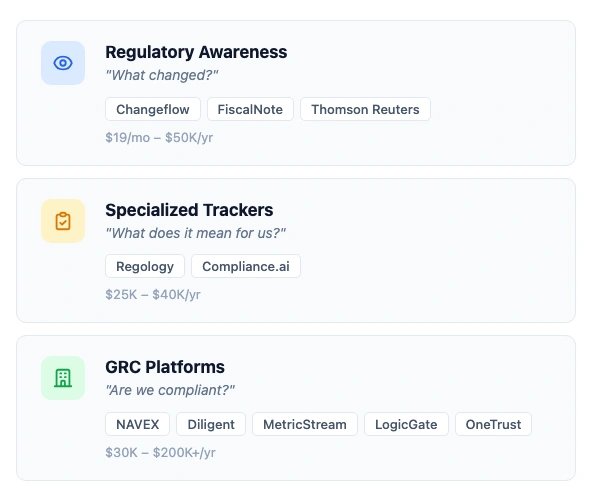
Regulatory awareness tools watch government websites, agency pages, and legal databases for changes. They answer the question: "what changed?" This is compliance monitoring in its most literal form. You point the tool at a source, and it tells you when something new appears.
GRC platforms manage the full compliance lifecycle: policies, controls, assessments, audits, remediation workflows, and reporting. They answer the question: "are we compliant?" These are enterprise systems that cost $50,000+ per year and take months to implement.
Specialized trackers sit between the two. They focus on specific regulatory domains (financial services, healthcare, environmental) and combine source monitoring with some workflow capabilities.
Most compliance teams need at least two of these categories. A GRC platform without regulatory awareness is flying blind. An awareness tool without a response workflow leaves findings sitting in an inbox.
Monitor regulatory pages automatically
Changeflow watches agency websites and tells you what changed and why it matters.
Free plan available. No credit card required.
What Changed for Compliance Monitoring in 2026
The market shifted shape over the past year. Three changes affect how buyers should evaluate tools today.
Source monitoring beat search. AI Overviews and generative search now answer regulatory questions directly in results, which broke the old "Google it weekly" awareness habit for compliance officers. Teams that need to be first now monitor agency pages directly rather than rely on inbound search to surface changes.
The state-level patchwork accelerated. State AI laws (Colorado, Utah, California, New York), state privacy laws beyond CCPA, and state-level financial regulators expanded monitoring scope significantly. Compliance teams that covered only federal sources in 2024 are materially under-covered in 2026. Mid-market specialists that pre-index US federal regulations only have a real coverage gap to close.
Vendor consolidation continued. Acquisitions across GRC, integrated risk management (IRM), and third-party risk management (TPRM) absorbed smaller specialists into platform suites. Buyers should evaluate vendor roadmap continuity alongside feature fit. A best-of-breed tool acquired into a platform may end up bundled, repriced, or sunset within 18 months of the deal.
These shifts pushed the buying conversation toward source-based awareness as the foundation, with GRC layered above for response. The reverse pattern (GRC-first, awareness as a bolt-on) leaves the awareness layer thin and dependent on whatever sources the GRC vendor happens to index.
The List at a Glance
| # | Tool | Category | Pricing Tier | Best For |
|---|---|---|---|---|
| 1 | Changeflow | Awareness | $99/mo (published) | Teams that need to monitor regulatory websites directly |
| 2 | FiscalNote | Awareness | Enterprise (demo only) | Pre-indexed multi-jurisdictional regulatory intelligence |
| 3 | Thomson Reuters Regulatory Intelligence | Awareness | Enterprise (demo only) | Financial services regulatory tracking with analyst commentary |
| 4 | Regology | Specialized | Mid-market to Enterprise | Mapping regulations to internal obligations |
| 5 | Compliance.ai | Specialized | Mid-market | AI-powered regulatory change analysis |
| 6 | NAVEX Global | GRC | Mid-market to Enterprise | Ethics and compliance program management |
| 7 | Diligent | GRC | Enterprise | Board-level compliance and governance |
| 8 | MetricStream | GRC | Enterprise | Large enterprise multi-framework compliance |
| 9 | LogicGate Risk Cloud | GRC | Mid-market | Flexible, no-code compliance workflows |
| 10 | OneTrust | GRC | Mid-market to Enterprise | Privacy-focused compliance (GDPR, CCPA) |
A note on pricing. Most enterprise compliance vendors don't publish prices. Mid-market tools typically run from low five figures to mid five figures annually, and enterprise GRC platforms can move into six figures depending on modules, seat counts, and integrations. Always get a written quote scoped to your org. Pricing tiers above reflect public information and analyst reports as of 2026.
1. Changeflow
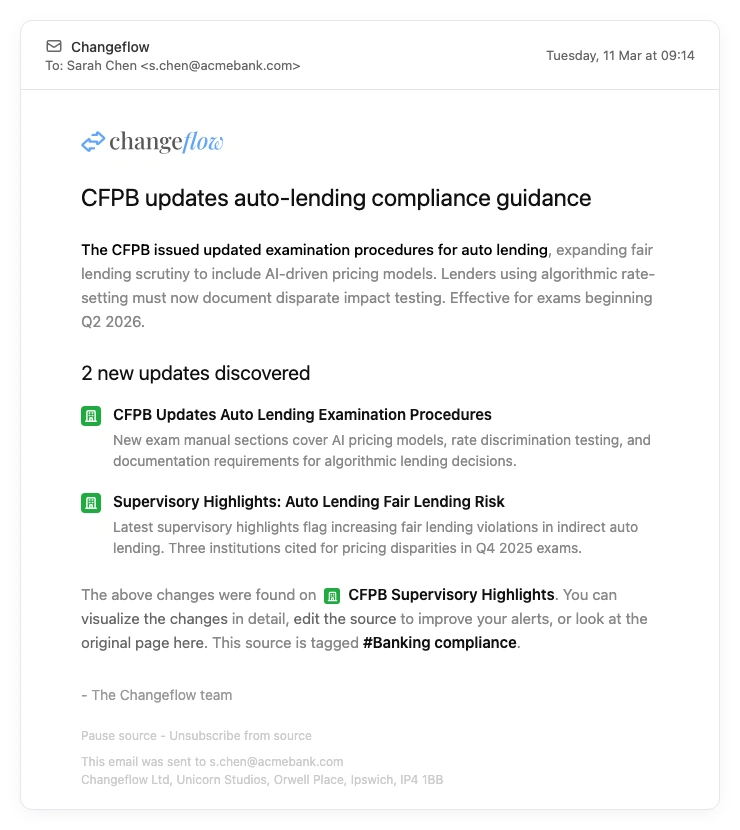
Changeflow monitors any web page and uses AI to filter changes by relevance. For compliance teams, this means pointing it at the specific government websites, agency pages, and regulatory databases that matter to your organization and getting alerts when content changes.
The approach is different from traditional regulatory intelligence platforms. Instead of curating a proprietary database of regulations, Changeflow watches the actual source pages. An FDA warning letters page. A state agency's guidance documents section. The Federal Register search results for your industry keywords.
You write a brief describing what you care about. The AI reads each page change and decides whether it matches your brief. If it does, you get a summary in your feed, Slack, or email. If it doesn't, it's filtered out. That's the difference between getting 40 raw alerts per day and 3 that actually matter.
Changeflow works well as the regulatory intelligence awareness layer. It catches changes that specialized databases miss because it monitors the web directly, not a curated subset. The tradeoff: you configure the sources yourself rather than getting a pre-built regulatory taxonomy.
Starting at: $99/month. Free 30-day trial.
Best for: Compliance teams that need to monitor specific government websites and want AI filtering without enterprise pricing.
2. FiscalNote
FiscalNote is the enterprise heavyweight in regulatory intelligence. It tracks legislation, regulations, and policy changes across federal, state, and international jurisdictions. The platform includes CQ (congressional tracking), Oxford Analytica (geopolitical risk), and VoterVoice (grassroots advocacy).
For compliance monitoring specifically, FiscalNote's strength is its pre-built regulatory coverage. You don't need to find the right government pages to monitor. The platform already indexes thousands of regulatory sources and maps changes to topics, jurisdictions, and industries.
The tradeoff is cost and complexity. FiscalNote is enterprise-priced (the platform doesn't publish rates publicly, and contracts are scoped per-org via demo), and configuration can take weeks. Smaller teams may find they're paying for coverage they don't need.
Best for: Large compliance teams that need pre-indexed multi-jurisdictional regulatory tracking with lobbying and policy intelligence bundled in.
3. Thomson Reuters Regulatory Intelligence
Thomson Reuters Regulatory Intelligence (TRRI) focuses specifically on financial services compliance. It covers 900+ regulatory bodies globally and provides expert analysis alongside raw regulatory content. Compliance officers get both the source material and an analyst's interpretation of what it means.
TRRI's editorial layer is what separates it from purely automated tools. When the OCC issues a new enforcement action, TRRI doesn't just detect the change. An analyst writes up the implications for banks, broker-dealers, and asset managers. Thomson Reuters also publishes Regulatory Intelligence Journals with deep-dive analysis of emerging trends.
The platform is strongest in banking, capital markets, and insurance regulation. If your compliance needs are outside financial services, the coverage thins out.
Best for: Financial services compliance teams that want analyst-curated regulatory intelligence with global coverage.
4. Regology
Regology maps external regulations to your internal compliance obligations. The platform ingests regulatory content, identifies changes, and then shows you which internal policies, controls, and processes are affected. This "regulatory mapping" step is where most compliance teams spend the most time manually.
The AI categorizes regulatory changes by topic, jurisdiction, and business impact. Compliance officers can see a regulatory change and immediately understand which business units and which controls it touches. Regology integrates with GRC platforms like ServiceNow and Archer, positioning itself as the intelligence layer that feeds your existing compliance infrastructure.
Best for: Mid-market to enterprise teams that need to connect regulatory changes to internal compliance obligations automatically.
5. Compliance.ai
Compliance.ai uses natural language processing to analyze regulatory documents and identify material changes. The platform covers US federal and state regulators, with particular depth in financial services agencies (SEC, CFPB, OCC, FINRA).
The differentiator is granular change analysis. Rather than flagging "something changed on this page," Compliance.ai identifies specific sections within regulatory documents that changed, categorizes the type of change (new requirement, amendment, guidance), and estimates the potential impact on your compliance program.
Best for: Financial services compliance teams that need document-level regulatory change analysis, not just page-level alerts.
6. NAVEX Global
NAVEX is a full compliance program management platform. It covers ethics hotlines, policy management, third-party risk, training, and incident management. The compliance monitoring component is one piece of a broader program.
For organizations building a compliance program from scratch, NAVEX provides the infrastructure. Hotline reporting, case management, policy attestation, and compliance training all live in one platform. The regulatory monitoring capabilities are more basic than specialized tools, but the integrated workflow means findings flow directly into case management.
Best for: Organizations that need a complete compliance program platform, not just regulatory monitoring.
7. Diligent
Diligent focuses on governance and compliance at the board level. The platform includes board management, entity management, audit management, and compliance oversight. After acquiring Galvanize (ACL/HighBond) in 2021, Diligent added analytics and continuous monitoring capabilities.
The compliance monitoring angle is risk-based. Diligent connects regulatory requirements to organizational risks, control testing, and audit findings. It's designed for compliance leaders who report to the board and need to demonstrate program effectiveness with data, not just activity metrics.
Best for: Public companies and financial institutions where compliance oversight is a board-level concern.
8. MetricStream
MetricStream is the legacy enterprise GRC player. The platform covers regulatory compliance, operational risk, audit management, and IT compliance across dozens of frameworks (SOX, HIPAA, PCI-DSS, GDPR, ISO 27001, and more).
MetricStream's regulatory monitoring includes a content library of regulations and standards that maps to your control framework. When a regulation changes, the platform highlights which controls need updating. The implementation is heavy. Expect 6-12 months to deploy and significant ongoing configuration.
Best for: Large enterprises managing compliance across 5+ regulatory frameworks simultaneously.
9. LogicGate Risk Cloud
LogicGate takes a no-code approach to compliance management. Instead of rigid, pre-configured workflows, Risk Cloud lets compliance teams build custom applications for their specific processes. Regulatory change management, vendor assessments, policy reviews, and incident tracking can all be configured without developer resources.
The flexibility is both the strength and the challenge. LogicGate doesn't prescribe a compliance methodology. You build your own. Teams with clear processes appreciate the flexibility. Teams looking for an opinionated framework may find it requires more upfront design work.
Best for: Mid-market compliance teams that want customizable workflows without the cost of enterprise GRC platforms.
10. OneTrust
OneTrust started as a privacy management platform (GDPR, CCPA compliance) and expanded into broader GRC. The privacy DNA still shows. OneTrust is strongest in data privacy compliance, consent management, and third-party risk assessment.
For organizations where privacy regulation is the primary compliance concern, OneTrust provides deep coverage. Data mapping, privacy impact assessments, cookie compliance, and consent preference management are all built-in. The GRC capabilities have grown, but competitors like MetricStream and NAVEX have more mature non-privacy compliance features.
Best for: Organizations where privacy compliance (GDPR, CCPA, state privacy laws) is the primary regulatory concern.
How to Choose the Right Category
Start with your actual problem. If you're honest about what's failing, the category picks itself.
"We don't know when regulations change." You need a regulatory awareness tool. Changeflow if you want to monitor specific sources with AI filtering. FiscalNote or Thomson Reuters if you want pre-indexed coverage across jurisdictions.
"We know regulations change but can't connect them to our obligations." You need a specialized tracker like Regology or Compliance.ai that maps external changes to internal controls.
"We have no compliance workflow infrastructure." You need a GRC platform. NAVEX for a full program. LogicGate for flexible, buildable workflows. MetricStream if you're enterprise-scale and multi-framework.
"We're drowning in privacy regulations." Start with OneTrust.
Many mature compliance teams run two tools. An awareness layer (Changeflow, FiscalNote, or Thomson Reuters) that detects changes, plus a GRC platform (NAVEX, Diligent, MetricStream) that manages the response. The awareness tool feeds the GRC platform. This is the same pattern described in our regulatory change management guide: awareness, assessment, action.
What's Missing From Most Lists
Most "compliance monitoring software" roundups are written by GRC vendors comparing themselves to other GRC vendors. They skip the awareness problem entirely.
Here's the gap: a GRC platform manages your compliance program. It tracks controls, schedules audits, stores policies, and generates reports. But it doesn't tell you when the CFPB publishes new supervisory highlights or when a state attorney general issues new enforcement guidance on your website.
That awareness gap is where penalties happen. The SEC enforcement sweep in 2024 didn't penalize companies for having bad compliance programs. It penalized them for not knowing about, or not responding to, disclosure requirements that had changed. You can't manage what you don't detect.
If you only buy one tool, buy the awareness layer first. You can manage responses in spreadsheets temporarily. You can't manually track website changes across 50 government agencies indefinitely. That's the part that breaks first, and it's the part automation solves best. For teams not ready to buy anything yet, free agency email subscriptions (SEC, OCC, CFPB, FINRA) cover formal announcements as a starting baseline.
Free vs Paid: When Each Makes Sense
A frequent question: can you do compliance monitoring without paid software? Partially. Here is what works at zero cost and where it breaks.
Free agency email subscriptions. SEC, OCC, CFPB, FINRA, FDA, and most regulators publish free RSS or email digests of formal rules and enforcement actions. These cover headline announcements but miss guidance updates, FAQ revisions, and quiet edits to compliance manuals on regulator websites. They also cover federal regulators only.
Federal Register email alerts. Free, fast, and authoritative for proposed and final rules. Useless for sub-regulatory guidance, which is where most day-to-day compliance changes actually live.
Google Alerts. Free but unreliable. Misses content behind agency search forms, does not cover most state regulators, and produces too much noise to be a serious monitoring layer for a regulated business.
RSS readers (Feedly, Inoreader). Free or low-cost personal awareness for an individual compliance officer. Not a team workflow. No filtering by relevance, no audit trail, no escalation paths.
Free monitoring works when: a small organization is regulated by one or two federal agencies, change frequency is low, and an internal review cadence can absorb a delay of days or weeks.
Free monitoring breaks when: a team is multi-jurisdictional, regulated by five or more agencies, or works in an industry where missing a guidance update has dollar or licensing consequences. At that point a paid awareness tool pays for itself the first time it catches a guidance change before the next supervisory exam.
Common Implementation Mistakes
Buying a GRC platform when you need monitoring. A $75,000/year GRC platform doesn't help if nobody knows a regulation changed. Fix the awareness problem first.
Monitoring too many sources at once. Start with 10-15 regulatory sources that directly affect your top compliance risks. Expand after you have a working response process. Our guide on how to monitor website changes covers the step-by-step setup for a first page, and our regulatory compliance examples page gives industry-specific starting points.
No response workflow for detected changes. Detection without a response process just creates a backlog of unread alerts. Define who reviews findings, how they're triaged, and what triggers a policy update before you turn on monitoring.
Ignoring agency websites. Most regulatory changes happen on agency websites, not in the Federal Register. Guidance updates, enforcement actions, FAQ changes, and policy interpretations live on FDA, OCC, and CFPB web pages. Our guide on tracking agency website updates covers how to set up automated monitoring for these sources. Tools that only index the Federal Register and Code of Federal Regulations miss this content. It's the horizon scanning blind spot that catches compliance teams off guard.
Industries With the Highest Stakes
Financial services faces the most overlapping regulatory exposure. Banks answer to the SEC, OCC, CFPB, FINRA, Federal Reserve, FDIC, and 50 state regulators. A single compliance gap can trigger enforcement from multiple agencies simultaneously. Teams already doing SEC filing monitoring should add agency website tracking for enforcement trends.
Healthcare and pharma operates under FDA, CMS, HHS, DEA, and state pharmacy boards. A missed FDA guidance update can delay a drug launch or trigger a warning letter. The cost of non-compliance isn't just fines. It's lost market access.
Legal teams at law firms monitor regulatory changes for dozens of clients simultaneously. A firm advising banks on BSA/AML compliance needs to track FinCEN, OCC, and state money transmitter regulators in parallel. The volume makes manual monitoring impossible.
Getting Started
If you don't have compliance monitoring software today, here's a practical starting point:
- List the 10 regulatory agencies that matter most to your organization
- Identify the specific web pages where each agency publishes guidance, enforcement actions, and rule changes
- Set up change detection on those pages with AI filtering tuned to your compliance priorities
- Route website alerts to the compliance team members responsible for each regulatory domain
- Review findings weekly and escalate material changes into your existing compliance process
You can be monitoring your top regulatory sources within an hour. The teams that catch regulatory changes early don't have bigger budgets or more staff. They just built a system that watches the right pages and filters out the noise.
Frequently Asked Questions
What is compliance monitoring software?
Compliance monitoring software helps organizations track regulatory changes, manage compliance obligations, and document adherence to laws and industry standards. These tools range from simple regulatory alert systems that watch government websites for changes to full GRC platforms that manage workflows, audits, and reporting across the entire compliance lifecycle.
How much does compliance monitoring software cost?
Prices range from $99 per month for website monitoring tools that track regulatory sources, to $50,000-200,000+ per year for enterprise GRC platforms. Mid-market solutions like Regology and LogicGate typically run $25,000-75,000 annually. Most vendors require a demo for pricing. Free options exist but lack AI filtering and workflow capabilities.
What's the difference between GRC software and compliance monitoring?
GRC (Governance, Risk, Compliance) platforms manage the full compliance lifecycle: policies, controls, audits, reporting, and remediation workflows. Compliance monitoring is specifically about detecting changes, such as new regulations, amended rules, or updated guidance. Many teams use both: a monitoring tool for awareness and a GRC platform for response.
Can compliance monitoring be automated?
Yes, partially. Tools like Changeflow and FiscalNote automate the detection of regulatory changes by monitoring government websites and databases. They can alert teams when something changes and summarize what happened. The assessment and response steps, deciding what a change means for your organization, still require human judgment in most cases.
What industries need compliance monitoring software most?
Financial services, healthcare, pharmaceuticals, energy, and any heavily regulated industry. Banks face overlapping requirements from the SEC, OCC, CFPB, FINRA, and state regulators. Pharma companies track FDA, EMA, and state pharmacy boards. Even less regulated industries increasingly need monitoring as data privacy laws (CCPA, state-level privacy acts) multiply.
Monitor regulatory sources automatically
Track government websites, agency pages, and regulatory databases. Get plain-English summaries of what changed.
Try Changeflow FreeNo credit card required
More from Learn

Wayback Machine for Legal Research: A Law Librarian's Guide
Half the URLs in old briefs are dead. Here is how law librarians use the Wayback Machine and stronger archives to verify citations, build timelines, and support litigation.

Law Librarian Current Awareness Audit Checklist (2026)
A 27-question audit covering coverage, cadence, relevance, distribution, resilience, and value. Built for law librarians and knowledge lawyers running current awareness at Am Law 200 firms.

Audit-Ready Web Archives: SEC 17a-4, FDA, and HIPAA Rules
Free archive tools fail under regulatory audit. Here is what SEC 17a-4, FDA 21 CFR Part 11, and HIPAA require from a web archive that holds up under examination.