
A 27-question audit covering coverage, cadence, relevance, distribution, resilience, and value. Built for law librarians and knowledge lawyers running current awareness at Am Law 200 firms.

Law Librarian Current Awareness Audit Checklist
Most law-firm current awareness programs have never been formally audited. The librarian or knowledge lawyer inherited an alert configuration from a predecessor, layered on partner requests over the years, and hoped nothing material was slipping through. The 2025 AALL State of the Profession Report covered 510 respondents and, per LawNext's summary, reported that over 70% of firm libraries support client alerts, docket tracking, or news monitoring for attorneys and business development teams. The survey does not say how many of those programs have been reviewed end-to-end against the firm's actual practice mix.
That gap is where the program drifts. Practice areas shift. Clients move into newly regulated industries. Vendors change products. Old alert sources go silent without a notification. Without a structured review, only the person who built the program knows what is and is not covered, which is the same as the firm not knowing.
This checklist is the audit. Twenty-seven questions across six sections. Walk through it once a year, fix the No answers in priority order, and the program stays defensible when a partner or KM committee asks. Designed for law librarians and knowledge lawyers running current awareness at Am Law 200 firms, but it scales down to mid-size, boutique, and corporate-counsel libraries with light editing.
How to Use This Checklist
A note on terminology. We call this an audit because that is what it is and what people search for. At many firms the same exercise is called a current awareness review or a service review, partly because "audit" carries compliance connotations that make some partners and committees twitchy. Use whichever word lands better internally; the questions don't care.
Run it once as a full audit (or review). Then schedule a quick sanity check after any of these triggers:
- A new client industry onboarded (especially a regulated one)
- An attorney moves practice groups, joins from another firm, or leaves
- A regulator publishes a major rule or restructures its website
- A monitoring source you'd expect to fire weekly or more often goes silent for 30 days (annual or seasonal sources don't count)
- A partner asks why they did not hear about something
Score by counting Yes answers. The remediation list (every No) matters more than the total. Tackle Coverage, Distribution, and Copyright gaps first. The other three sections can be addressed within a quarter without firm-wide drama.
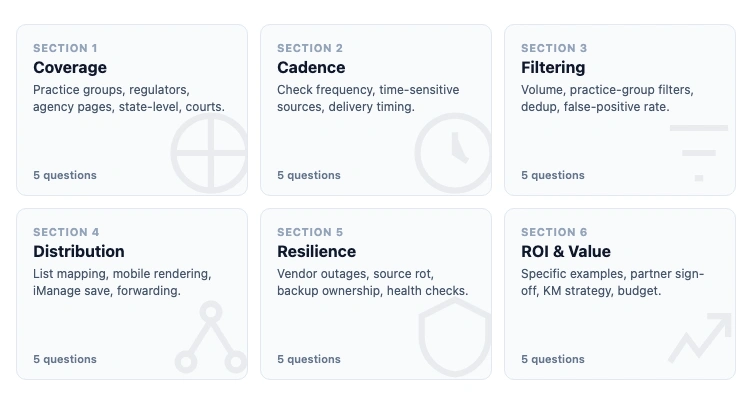
Paste a URL. We'll do the rest.
Changeflow monitors the page and tells you what changed and why it matters.
Free plan available. No credit card required.
Section 1: Coverage (5 questions)
The most common audit failing. Tier 1 here means the flagship research platforms with built-in alerting (Westlaw Precision, Lexis+, Bloomberg Law, HeinOnline). Most firms cover those well and have weak or accidental coverage of agency content outside those databases.
- Have you mapped every active practice group to its top monitoring sources within the last 12 months, against the current client and matter list from the firm's PMS (Aderant Expert, Elite 3E, or equivalent)?
- For every regulated client industry, do you have at least one monitoring source per primary regulator (SEC, FDA, OCC, CFPB, FINRA, FERC, FTC, EPA, etc.)? Pharma practice teams should also cover the FDA and CMS pages and the relevant state DOH pages where guidance shifts most often.
- Are agency pages outside the Federal Register on a monitoring layer (guidance pages, enforcement pages, FAQ pages, no-action letters, sub-regulatory bulletins)? Westlaw and Lexis+ index their own content; agency websites often go untouched.
- Do you cover state-level regulators where clients are licensed (state attorneys general, state insurance commissioners, state financial regulators, state environmental agencies)?
- Are court websites monitored for the court types relevant to your firm's litigation practice (federal circuit courts, state supreme courts, specialized courts like the Federal Circuit or Court of International Trade)?
The Federal Register and the Tier 1 research platforms are the safe layer. Agency and court websites outside those databases are where most firms have unknown gaps. Our guide on tracking government website changes is a useful starting source list.
Section 2: Cadence (4 questions)
Cadence failures are usually invisible until a partner notices a delay. They are also the easiest section to fix.
- Is every monitored source on a known, documented check frequency (real-time, hourly, daily, weekly)? This applies to platform alerts (KeyCite, WestClip, Shepard's, Bloomberg Law topic alerts) and to standalone source monitoring.
- Are time-sensitive sources on at least daily cadence, with breaking-news sources on a higher cadence? Court filings, SEC enforcement announcements, FDA warning letters, and Law360 practice-area dailies publish during US business hours, not overnight; a single 6am sweep misses anything posted after.
- For firms with offices in multiple time zones (East Coast, West Coast, or international), is there a documented split on which library or knowledge team owns same-day distribution for which regions?
- Is there an explicit re-check process after planned outages (vendor maintenance windows, holidays, librarian leave) so nothing is silently missed in the gap?
Section 3: Relevance and Filtering (4 questions)
If attorneys ignore the briefing, the program has failed regardless of coverage. Susannah Tredwell put it directly in her Slaw column on current awareness in law libraries: "because lawyers get so much email it is important to keep the number of current awareness alerts to a minimum, while still making sure the information is timely." Volume discipline is half the job.
- Has every active recipient confirmed in the last 6 months that the volume of items they receive is at the right level? Open rates and click data from Vable, Manzama, Lexology Newsstand, or whichever distribution platform you run on belong here, not just self-report.
- Does each practice-area briefing have a documented relevance rule that excludes off-topic items, and does that rule get reviewed when the practice group's client mix shifts?
- Is duplicate content suppressed when the same regulatory event hits multiple sources (the SEC press release, the Law360 daily, the Bloomberg Law note, the firm's own blog)? Vable group profiles, Manzama topic profiles, and Lexology Newsstand handle a lot of this automatically; bespoke or in-house setups often do not. Law360 in particular is high-volume across its 40+ practice-area newsletters, and dedupe rules need to know it.
- Do you distinguish between minor edits or clarifications and material changes when alerting? An agency typo correction does not warrant a partner email; a guidance amendment does.
The Vable platform is built around the principle that curation, not aggregation, is the value-add. The regulatory change management pattern in compliance teams is the same: detection alone is not the deliverable.
Section 4: Distribution and Copyright (5 questions)
Two issues that get conflated and need to be separated. Distribution is how the briefing reaches the lawyer. Copyright is whether you are allowed to send it that way.
- Is every active attorney mapped to at least one practice-area briefing, and is the list updated within 5 business days when an attorney joins, leaves, or changes groups? (UK readers: substitute "fee earner".)
- Where do briefings actually live: email, SharePoint, Teams, intranet, all of the above? Per LawNext's summary of the AALL 2025 SOTP, 74% of firm libraries use SharePoint and 63% use Microsoft Teams. Email-only distribution is increasingly the exception, not the default.
- Does each briefing render correctly on mobile? Partners read briefings on phones in transit, on the way to court, and over breakfast. A formatting failure on iOS Mail or the Outlook mobile app is a delivery failure even if the email reached the inbox. Note that "delivered" is not "read": a briefing routed by the recipient's Outlook rule into a folder they never open scores 100% on delivery and 0% on impact. Open-rate metrics from Vable or Manzama tell you which is which.
- Copyright check. Have you reviewed the licence terms of every paid source the briefing redistributes? Tredwell's Slaw column makes the practical distinction: routing a print copy with a circulation slip is fine, but scanning the same content and sending it by email may not be, depending on the publisher's terms. Internal redistribution is sometimes allowed; onward client forwarding is often not. A licence breach surfaced by a vendor audit lands on the managing partner's desk.
- For client-forwardable briefings (alerts written for partners to send onward), is the format clean, the attribution clear, the source linkable, and the redistribution permitted? Many firms separate client-facing alerts from internal awareness specifically to avoid copyright exposure.
The point of separating Distribution from Copyright is that the technical question (does it arrive cleanly) and the licence question (are we allowed to send it) have different owners. The technical question lives with IT and KM. The licence question lives with the librarian and procurement.
Section 5: Resilience and Source Health (4 questions)
What happens when sources change, vendors fail, or the person who built the program is on leave.
- When a source URL changes (a regulator redesigns its website, an agency moves a guidance page, a court adopts a new docket system), does an alert fire, or does the source quietly stop reporting?
- Is there a quarterly source-health check (every monitored source returned at least one alert in the last 90 days, or has a documented reason for silence)? Silence is not always good news.
- Are at least two team members trained to run distribution if the primary owner is on leave or moves on? UK firms commonly split this between library staff and PSLs; US firms often have a single owner with no documented backup.
- When a regulator publishes through a new channel (a new microsite, a new press-release feed, a new RSS endpoint), is there a process to capture and add it within 30 days?
Source rot is real and constant. Government and regulator websites redesign every 2 to 3 years. Every redesign breaks at least one monitoring rule. A program that does not fail loudly when a source breaks is a program that is silently incomplete. A change detection layer that fires on structural changes (page moved, content disappeared, layout altered) catches these before partners do.
Section 6: Value, ROI, and Defensibility (5 questions)
The hardest section because most current awareness work is non-billable, recovered as overhead, and consumed without attribution. The AALL 2025 SOTP reports that 88% of firm libraries regularly track and share usage metrics, with the billable-versus-nonbillable breakdown among the commonly tracked indicators. Current awareness sits firmly on the nonbillable side at most firms, which makes it politically vulnerable when budgets tighten.
A note on the AI tooling gap. The same AALL 2025 data shows 68% of firm libraries have a formal generative AI policy in place but only 30% require training before access. That asymmetry matters here: a policy that permits Lexis+ AI, Vable AI, or Bloomberg Law's AI features without operational training is cost without value. The audit is one place to flag it.
- Can you list 5 specific examples in the last 12 months where current awareness caught something that affected client work, matter strategy, or business development? Walk-through prompts in our regulatory compliance examples guide may help if you are stuck.
- Have at least one practice group leader and one BD or marketing lead confirmed in writing in the last 6 months that the briefings affect how their team works? Verbal "thanks, that's useful" does not count for KM committee defensibility.
- Has at least one current awareness alert been quoted, embedded, or attributed in a client-facing piece (deal memo, client alert, partner briefing) in the last 12 months?
- Is current awareness in the firm's KM strategy document, with a stated owner, budget, and stakeholder list, and has the budget been reviewed in the last 12 months against the firm's actual practice mix?
- If your firm subscribes to AI features inside Westlaw, Lexis+, Bloomberg Law, Vable, or any other current awareness tool, has someone been trained on prompting and result review for that tool, beyond the policy sign-off?
The five-examples question is the most defensible artifact. If you cannot list five, the program is invisible to the people who pay for it, and invisibility is functionally the same as not existing. Framing matters too. A sentence like "we flagged the CFPB's updated supervisory highlights two days before it indexed on Bloomberg Law, and the consumer finance team used it in the Q3 client briefing" protects the budget. "We sent 240 alerts last quarter" does not.
How to Score
Count Yes answers across all 27 questions:
- 22-27: Mature program. Run the audit again next year. Spot-check the No answers in the next 90 days.
- 17-21: Functional with known gaps. Coverage, Distribution, and Copyright gaps are the priority. Plan a remediation quarter.
- 11-16: Significant gaps. The program is running on inertia. Schedule a workshop with the library team and identify the top 5 fixes within 30 days.
- Under 11: High risk. The program needs a structural review, not a tune-up. Consider whether the firm needs to invest in a current awareness platform, dedicate librarian or PSL time, or both.
The score is less useful than the remediation list. Any No in Coverage, Distribution, or Copyright is a near-term fix. Resilience is mid-term. Cadence and Relevance can be addressed by the next audit cycle.
What to Do With the Results
Three moves that work after a real audit:
Share the failures, not just the score. "We have no monitoring on the New York DFS pages for our financial services clients" is a partner-readable statement. "We scored 19 of 25" is not.
Convert No answers to a 90-day remediation plan. Each No becomes a single line: source to add or replace, person to own it, deadline, what success looks like. The plan is the artifact you take to the KM committee or the head of practice.
Schedule the next audit on the calendar today. Annual cadence sticks if it is on the calendar, with a reminder, and an owner. It does not stick if it is on a to-do list. Programs that skip an annual cycle tend to resume only when an external trigger forces it: a partner complaint, an exam finding, a new KM lead arriving.
The audit itself is not the value. The remediation is. A program that scored 16 last year and 21 this year is more defensible than a program that scored 24 once and was never reviewed again.
Sources and Methodology
Every quantitative claim in this checklist is traceable to a named source, linked in the body where it is used. The framework is built on practitioner-published material from AALL, BIALL, and Slaw, plus publicly documented platform features from Vable and Manzama (Diligent). Specific sources:
- AALL 2025 State of the Profession Report (510 respondents). Quoted figures (70%+ supporting client alerts/docket/news monitoring; 88% tracking usage metrics; 74% SharePoint, 63% Teams; 68% formal AI policy / 30% requiring training; HeinOnline / Westlaw / Lexis+ / Bloomberg Law as most popular subscriptions) are drawn from Bob Ambrogi's LawNext summary of the report. The full report is available for purchase from AALL.
- BIALL Law Firm Library Survey: UK and Ireland law firm library benchmark series (most recent published edition: 2022). The 2025 survey was open for responses in April 2025 and is published in BIALL members' area and Legal Information Management.
- Susannah Tredwell, Current Awareness Services in Law Libraries (Slaw, 2016): directly quoted in Section 3 and cited in the Section 4 copyright question. The point that print routing is generally fine but emailing scanned PDFs may breach the publisher's licence is hers, and the formulation of the volume-discipline argument is also hers.
- Vable and Manzama (Diligent): feature names (group profiles, topic profiles, NLP feeds, automated dedupe) are publicly documented vendor capabilities, used here descriptively rather than evaluatively.
The audit categories where no single source quantifies the question (coverage gaps for sub-regulatory content, source rot, copyright exposure on redistribution, KM-committee defensibility) are framed as audit questions rather than statistical claims. The structure draws on practitioner reporting from BIALL Conference proceedings, AALL listserv discussion, and Slaw's columns archive.
A note on our own redistribution practice: facts and statistics are not copyrightable, but the wording around them is. Where we have used a contributor's distinctive phrasing (Tredwell, in particular), we quote with attribution rather than paraphrase. If you spot a sentence that should be quoted but is not, or a claim that lacks a clear source, email steve@changeflow.com and we will revise.
Frequently Asked Questions
How often should a law librarian audit current awareness?
Once a year as a full audit, plus a 15-minute sanity check after any major regulatory shift, attorney practice change, new client onboarded into a regulated industry, or a partner asking why they did not hear about something. Most firms have never done a structured audit, which is why the same gaps show up in firm after firm.
What is the biggest gap most law-firm current awareness setups have?
Agency websites and regulator content outside the Federal Register. Westlaw, Lexis+, Bloomberg Law, and HeinOnline cover their own databases well. Almost no firm has a clean monitoring layer for agency guidance pages, FAQ updates, or quietly-edited regulator content. That gap is where missed deadlines, missed limitations periods, and uncomfortable client questions live.
Who actually runs current awareness at a law firm?
It depends on the firm. UK firms typically split it between the library and Professional Support Lawyers (PSLs). Many US Am Law firms run it through library staff, knowledge lawyers, or both. Dedicated current awareness librarian roles are more common at the largest firms but far from universal. Use the audit to surface where ownership per practice group is fuzzy and sources fall between team members.
What about copyright when forwarding briefings to clients?
It depends on each subscription's terms. Routing a physical periodical is generally fine. Scanning it and emailing a PDF copy is often not, depending on the publisher's licence. Some publishers permit internal redistribution but not client forwarding. The audit includes a copyright check because licence breach is a real and overlooked exposure.
How do I score the audit if I have never done one?
Run through the 27 questions and count Yes answers. 22 or above means a mature program. 17 to 21 means functional with known gaps. Below 17 means a high risk of missed updates. The remediation list is more useful than the score: any No answer in Coverage, Distribution, or Copyright is worth fixing within a quarter.
Close the agency-page coverage gap your audit just exposed
Watch the regulator and court pages your Tier 1 platforms don't index. AI filtering against your brief, plug into Vable, Manzama, SharePoint, or email.
Try Changeflow FreeNo credit card required
More from Learn

Wayback Machine for Legal Research: A Law Librarian's Guide
Half the URLs in old briefs are dead. Here is how law librarians use the Wayback Machine and stronger archives to verify citations, build timelines, and support litigation.

Audit-Ready Web Archives: SEC 17a-4, FDA, and HIPAA Rules
Free archive tools fail under regulatory audit. Here is what SEC 17a-4, FDA 21 CFR Part 11, and HIPAA require from a web archive that holds up under examination.

What Regulatory Change Management Software Actually Costs
Real pricing data for 14 regulatory change management platforms, from LogicGate at $52K median to MetricStream crossing $1M. What is public, what we reconstructed from funding and filings, and what the vendors refuse to publish.