
What is dynamic pricing? Real examples from Amazon, Uber, and airlines. Learn the types, see what's legal, and start monitoring competitor price changes.

Your competitor changed their prices three times last week. You found out about one of them. Maybe.
That's the reality of dynamic pricing in 2026. Prices move constantly. The businesses that win are the ones that see the changes, understand the patterns, and respond fast.
This guide breaks down how a dynamic pricing strategy works, who uses it, the different types, and (the part most guides skip) how to actually track when your competitors adjust their prices.
What Is Dynamic Pricing?
Dynamic pricing means adjusting prices based on current market conditions. Supply and demand, competitor behavior, time of day, inventory levels, customer segments. The price isn't fixed. It moves.
Airlines pioneered this in the 1980s. They called it "yield management." A seat on the same flight might cost $200 on Tuesday and $600 on Friday. Same seat. Different price. Because demand is different.
What started as an airline tactic is now standard business practice. Harvard Business School Online teaches dynamic pricing as a core strategy. Amazon changes prices on millions of products 2.5 million times per day. Uber adjusts ride prices minute by minute. Hotels change room rates based on occupancy and local events.
The core idea is simple: charge more when demand is high, charge less when demand is low. The execution is where it gets complicated.
Track competitor prices on any website
Changeflow monitors pricing pages and tells you exactly what changed. Set it up in 30 seconds.
Free plan available. No credit card required.
How Dynamic Pricing Works
Every dynamic pricing system needs three things:
1. Data inputs. What information drives the price? This could be demand signals (search volume, conversion rates, cart additions), competitive prices, inventory levels, time of day, weather, events, or historical patterns.
2. Pricing rules or algorithms. These range from simple rules ("if inventory drops below 20%, raise price 10%") to machine learning models that weigh dozens of factors simultaneously. The algorithm decides what the new price should be.
3. Execution speed. How fast can you change the price? For Amazon, it's milliseconds. For a B2B SaaS company, it might be quarterly. The speed needs to match your market.
A McKinsey analysis found that a 1% improvement in pricing leads to an 8% increase in operating profit. That's more impact than a 1% improvement in volume (3.3%) or fixed costs (2.3%). Pricing has more impact than almost any other factor most businesses touch.
Types of Dynamic Pricing
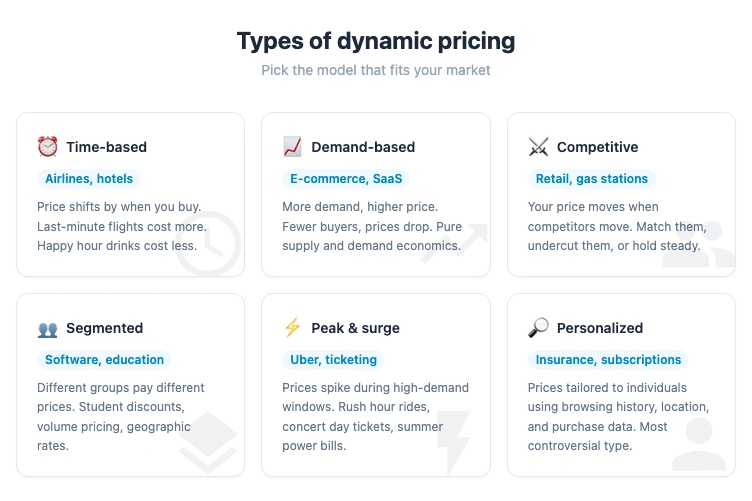
Not all dynamic pricing works the same way. Here are the main types.
Time-Based Pricing
Prices change based on when you buy. Airlines charge more for last-minute bookings. Hotels charge more on weekends. Happy hour drinks cost less because bars need to fill seats at 4 PM.
Who uses it: Airlines, hotels, restaurants, entertainment venues, parking garages.
Demand-Based Pricing
Prices respond to real-time demand signals. More people searching for a product? Price goes up. Sales slowing down? Price drops. This is the purest form of supply-and-demand pricing.
Who uses it: E-commerce, ride-sharing (Uber and Lyft), event ticketing, cloud computing (AWS spot instances).
Competitive Pricing
Your price moves based on what competitors charge. If a competitor drops their price, you match it or undercut it. If they raise prices, you might hold steady to capture their customers. Or follow them up.
Who uses it: Retail, e-commerce, gas stations, grocery stores. Any market where customers actively comparison shop.
Segmented Pricing
Different customers pay different prices for the same product. Student discounts. Senior pricing. Geographic pricing based on location. Volume discounts for large buyers. The product is the same. The price depends on who's buying.
Who uses it: Software (per-seat pricing), education, entertainment, international markets with different purchasing power.
Peak and Surge Pricing
Prices spike during high-demand periods. Uber's surge pricing during rush hour. Concert ticket prices on the day of the show. Electricity rates during summer afternoons when everyone runs their AC.
Who uses it: Ride-sharing, utilities, event ticketing, seasonal retail.
Personalized Pricing
Prices tailored to individual customers based on browsing history, purchase history, location, device, or other personal data. This is the most controversial type. The same product, different price, based on what the company thinks you'll pay.
Who uses it: Some e-commerce platforms, insurance, subscription services. Increasingly under regulatory scrutiny.
Real Dynamic Pricing Examples
Amazon
Amazon is the most aggressive dynamic pricer in retail. Their algorithms adjust millions of prices daily, responding to competitor prices, demand patterns, inventory levels, and margin targets.
If you've ever watched an Amazon product price bounce between $24.99 and $31.49 over a week, you've seen dynamic pricing in action. Amazon's goal: win the Buy Box and maximize profit per order. They'll drop prices to undercut competitors, then raise them once the competition is gone.
Uber and Lyft
Uber's surge pricing is the most visible example of dynamic pricing. When demand for rides exceeds available drivers, prices multiply. The NBER found that Uber's dynamic pricing generated $2.88 billion in consumer surplus in 2015 alone, because the alternative wasn't lower prices. It was no ride at all.
The surge multiplier can go from 1x to 3x or higher during events, bad weather, or holiday weekends. Drivers earn more, which attracts more drivers online, which eventually brings prices back down.
Airlines
Revenue management is the foundation of airline profitability. A flight with 180 seats might have 10 or more fare classes, each with different prices. Seats in the same row on the same flight sell for wildly different amounts depending on when they were booked, how full the flight is, and competitor pricing on the same route.
Marriott International reported that its revenue management system increased annual profit by $46 million after implementation. Airlines typically see 2-5% revenue gains from pricing alone.
SaaS and B2B
Dynamic pricing in B2B looks different. It's usually not algorithmic. It's negotiated. A SaaS company might list $99/mo but offer $69/mo to close a deal. Volume discounts, annual prepay discounts, competitive switch offers. The "list price" is a starting point, not a final answer.
Some B2B companies are moving toward more structured dynamic pricing. Usage-based pricing (pay per API call, per seat, per gigabyte) is inherently dynamic because the total cost changes with consumption.
Dynamic Pricing in B2B vs B2C
| Factor | B2C Dynamic Pricing | B2B Dynamic Pricing |
|---|---|---|
| Speed | Real-time (seconds/minutes) | Days to weeks |
| Transparency | Price visible to everyone | Often negotiated privately |
| Automation | Highly automated | Usually manual or semi-automated |
| Data sources | Demand, competition, inventory | Contract terms, relationship, volume |
| Customer reaction | Accepted (airlines, Uber) | Sensitive (trust matters more) |
| Monitoring need | Watch competitors constantly | Track contract renewals, market shifts |
B2C dynamic pricing is accepted because consumers understand that flight prices change. Nobody expects a plane ticket to cost the same every day.
B2B is different. When your software vendor raises prices mid-contract, that erodes trust. B2B dynamic pricing works best when it's transparent: volume discounts, usage-based billing, published annual price adjustments. Not surprise price hikes.
For B2B companies tracking competitor pricing shifts, automated website change detection catches changes you'd miss manually. When a competitor quietly adjusts their pricing page, you want to know about it before your next sales call.
The Legal Side of Dynamic Pricing
Dynamic pricing is legal. But the line between "smart pricing" and "discriminatory pricing" is getting thinner.
What's Clearly Legal
- Changing prices based on supply and demand (airlines, Uber, Amazon)
- Time-based pricing (happy hour, seasonal sales, early bird discounts)
- Geographic pricing based on market conditions
- Volume discounts
- Competitive price matching
What's Getting Scrutiny
The FTC launched an investigation into "surveillance pricing" in 2025, examining how companies use personal data to set individual prices. They ordered eight companies to explain how they collect and use consumer data for pricing decisions.
The concern: if you're charging different prices based on browsing history, location data, or demographic information, that starts looking like discrimination. The FTC's investigation covers companies including Mastercard, JPMorgan Chase, and several pricing firms.
Several states are considering legislation. California and New York have proposed bills requiring transparency when prices are set by algorithms. The EU's AI Act already requires that AI-driven pricing systems meet certain transparency standards.
The DOJ vs RealPage Case
The Department of Justice filed suit against RealPage, alleging their algorithmic pricing tool allowed landlords to coordinate rental prices. Multiple landlords feeding data into the same algorithm and following its pricing recommendations looks a lot like price fixing, even if no humans explicitly agreed on prices.
This case matters for dynamic pricing broadly. If using a shared pricing algorithm counts as coordination, that changes the rules for any industry where multiple competitors use the same pricing software.
Staying in the Safe Zone
Keep your dynamic pricing legal by:
- Basing prices on market conditions, not protected characteristics
- Applying the same pricing logic to all customers in a segment
- Being transparent about how prices are set
- Not coordinating with competitors on pricing (even through shared tools)
- Monitoring for compliance with evolving regulations
How to Monitor Competitor Dynamic Pricing
If your competitors use dynamic pricing, you need to know when and how their prices move. Not last week's snapshot. Today's reality.
Why Manual Price Checking Fails
Manual checking misses the patterns. You check a competitor's pricing page on Monday and Friday. But they changed prices Tuesday, Wednesday, and Thursday. You saw none of it.
Dynamic pricing makes this worse. Prices might change three times a day. By the time you manually check, the price has already moved again.
Automated Price Monitoring
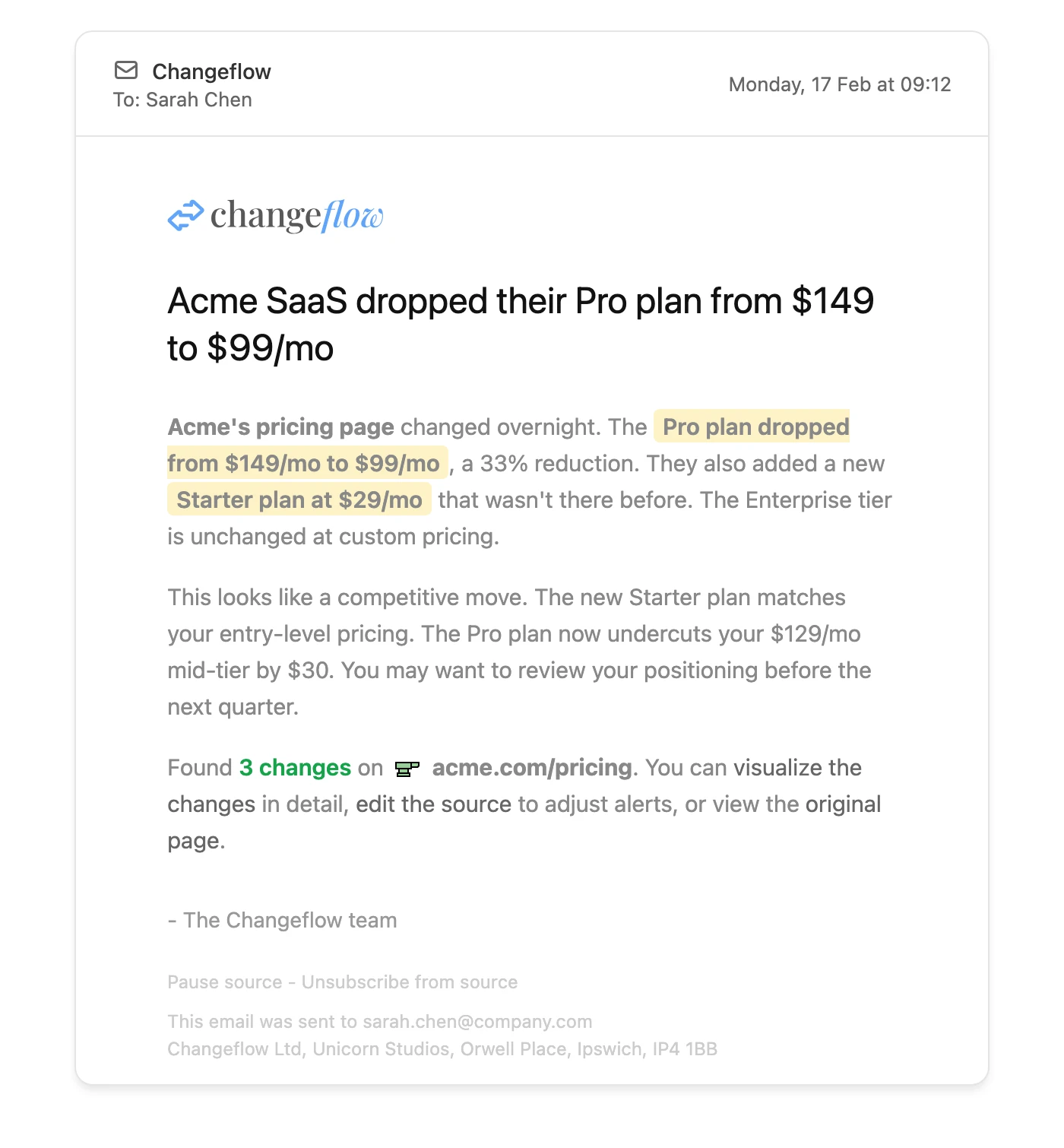
Changeflow monitors competitor websites for changes, including pricing pages. Set up a track on your competitor's pricing page, tell the AI what matters ("alert me when prices, tiers, or features change"), and get notifications with summaries of exactly what shifted.
What you can track:
- Competitor pricing pages for price tier changes
- Feature comparison pages for bundling shifts
- Terms and conditions for usage limit changes
- Product pages for positioning shifts alongside price moves
The value isn't just knowing the current price. It's seeing the pattern. Does this competitor drop prices every quarter? Do they raise prices right after funding announcements? Do they discount for certain segments?
For dedicated e-commerce price tracking, see our guide to competitor price tracking tools. For broader market monitoring, price intelligence tools offer deeper analytics.
Building Your Dynamic Pricing Strategy
Not every business needs real-time algorithmic pricing. But every business should think about pricing as a dynamic decision, not a set-and-forget choice.
Start With Monitoring
Before you build your own dynamic pricing system, understand your market. Track changes on competitor websites to see how frequently prices shift in your space. If competitors change prices quarterly, you don't need a real-time system. If they change daily, you do.
Choose Your Approach
Pick the dynamic pricing type that fits your business:
- E-commerce: Competitive pricing based on market data. Use price intelligence tools for automated monitoring.
- SaaS/B2B: Usage-based or value-based pricing with periodic adjustments. Track competitor pricing pages to time your own changes.
- Retail: Consider whether EDLP or dynamic pricing fits your brand. Both work. They attract different customers.
- Regulated industries: Price changes need compliance review. Build in approval workflows and maintain audit trails.
Set Guardrails
Even with automation, you need rules:
- Floor price: Never go below your cost plus minimum margin
- Ceiling price: Cap increases to avoid price gouging claims
- Change frequency: How often can prices shift before customers get frustrated?
- Notification plan: When do you tell customers about changes?
- MAP compliance: If you sell through retailers, respect minimum advertised pricing
Measure and Adjust
Track these metrics after implementing dynamic pricing:
- Revenue per unit: Is it trending up?
- Conversion rate: Are price changes hurting sales?
- Customer complaints: Are people noticing and reacting negatively?
- Competitor response: How do competitors react to your price changes?
- Margin: Are you actually making more money?
Use competitive intelligence tools to track how your market responds to your pricing shifts. The best pricing strategy adapts based on results, not predictions.
Start Tracking Price Changes Today
Dynamic pricing is only getting more common. Whether you're implementing it yourself or competing against companies that use it, visibility into pricing movements is the starting point.
Track your competitors' pricing pages with Changeflow and build a picture of how your market actually prices. The data tells you more than any strategy document.
Track competitor pricing changes automatically
Get alerts when competitors adjust their prices. See what changed and by how much.
Try Changeflow FreeNo credit card required
More from Learn

Wayback Machine for Legal Research: A Law Librarian's Guide
Half the URLs in old briefs are dead. Here is how law librarians use the Wayback Machine and stronger archives to verify citations, build timelines, and support litigation.

Law Librarian Current Awareness Audit Checklist (2026)
A 27-question audit covering coverage, cadence, relevance, distribution, resilience, and value. Built for law librarians and knowledge lawyers running current awareness at Am Law 200 firms.

Audit-Ready Web Archives: SEC 17a-4, FDA, and HIPAA Rules
Free archive tools fail under regulatory audit. Here is what SEC 17a-4, FDA 21 CFR Part 11, and HIPAA require from a web archive that holds up under examination.