
What MAP pricing is, how brands enforce minimum advertised prices, how to spot violations across retailers, and how to protect your margins.

MAP pricing is the invisible fence that keeps retail pricing from falling apart. If you sell products through retailers (online or off), understanding minimum advertised pricing isn't optional. It's the difference between protecting your brand margins and watching a price war destroy them.
This guide covers what MAP pricing actually is, why it's legal, how to create a policy, and (the part most guides skip) how to actually enforce it by monitoring retailer compliance at scale.
What Is MAP Pricing?
MAP stands for Minimum Advertised Price. It's the lowest price a manufacturer or brand allows retailers to advertise a product for.
Key word: advertise. MAP controls what retailers can show publicly. On their website, in emails, on Google Shopping, in print ads. But MAP does not control the actual selling price. A retailer can sell below MAP at the register, in their cart, or during a private negotiation. They just can not show that lower price publicly.
Think of it this way: if a customer has to add the product to their cart to see the real price ("See price in cart"), the retailer is likely working around a MAP policy. The advertised price stays at or above MAP. The checkout price can be anything.
This distinction matters. MAP is about brand protection, not price fixing. The FTC recognizes the difference.
Track competitor prices on any website
Changeflow monitors pricing pages and tells you exactly what changed. Set it up in 30 seconds.
Free plan available. No credit card required.
Is MAP Pricing Legal?
Yes. In the United States, MAP pricing is legal.
The landmark case is Leegin Creative Leather Products v. PSKS, Inc. (2007). The Supreme Court ruled that manufacturer pricing agreements should be evaluated under the "rule of reason" rather than being automatically illegal under the Sherman Antitrust Act.
What this means in practice: brands can set MAP policies and enforce them, as long as:
- The policy is applied consistently across all retailers
- It's a unilateral policy (not a price-fixing agreement between competitors)
- Enforcement is non-discriminatory
Before Leegin, the Dr. Miles ruling (1911) treated all resale price maintenance as per se illegal. Leegin overturned that century-old precedent. Now, MAP policies are evaluated on a case-by-case basis to determine if they promote or harm competition.
A few caveats. Some states (California, for one) have stricter interpretations. And MAP must be a manufacturer's unilateral policy, not a horizontal agreement among competing brands. If two brands agree to set the same MAP, that's price fixing, and that's still very much illegal.
How MAP Pricing Works in Practice
A typical MAP program follows this cycle:
1. Brand sets MAP. The manufacturer decides the minimum advertised price for each product. This is usually set as part of the wholesale agreement.
2. Retailers agree to the policy. When onboarding, retailers sign or acknowledge the MAP policy as a condition of carrying the brand.
3. Brand monitors compliance. The brand (or their team) watches retailer advertising for MAP violations. This includes websites, email campaigns, marketplace listings, and ad platforms.
4. Violations are flagged and addressed. When a retailer advertises below MAP, the brand takes enforcement action according to their policy.
5. Repeat. Monitoring is ongoing. One violation fixed today doesn't mean the same retailer won't try again next week.
MAP vs MSRP vs UPP
These three terms get confused constantly. Here's the difference.
| Term | What It Means | Enforceable? | Controls What? |
|---|---|---|---|
| MAP | Minimum Advertised Price | Yes (policy-based) | Advertised price only |
| MSRP | Manufacturer's Suggested Retail Price | No (suggestion only) | Nothing, it's a recommendation |
| UPP | Unilateral Pricing Policy | Yes (stricter than MAP) | Both advertised AND selling price |
MSRP is a suggestion. A brand puts "$99.99" on the box and hopes retailers sell at or near that price. But there's no enforcement mechanism. Retailers can sell at whatever price they choose.
MAP restricts advertising. The retailer can sell for less, but the customer has to get to checkout to see the lower price. Most e-commerce brands use MAP.
UPP (Unilateral Pricing Policy) is the strictest option. It controls both the advertised price and the actual selling price. UPP is rarer because it's harder to enforce and more legally complex.
For brands selling through third-party retailers, MAP hits the sweet spot between brand protection and retailer flexibility. It prevents a race to the bottom in advertising while still letting retailers compete on service, bundling, and after-sale value.
Real MAP Pricing Examples
Consumer Electronics
Apple is famously strict about pricing. While they don't publicly call it MAP, their authorized reseller agreements effectively function the same way. You'll rarely see a new iPhone advertised below retail price. Authorized retailers compete on service, trade-in deals, and bundles instead.
Sporting Goods
Brands like Yeti, Patagonia, and The North Face enforce MAP policies to maintain premium positioning. A Yeti cooler costs the same whether you buy it from REI, Dick's Sporting Goods, or a small outdoor shop. That consistency is the point.
Power Tools
DeWalt, Milwaukee, and Makita all maintain MAP policies. This protects smaller hardware stores that can not compete on volume pricing with Home Depot. Without MAP, the big-box stores would advertise rock-bottom prices and drive the independents out.
Luxury Goods
High-end brands use MAP (or stricter policies) to prevent discounting that would erode brand perception. A Bose speaker advertised at 40% off suggests it wasn't worth the original price. MAP prevents that signal from reaching the market.
How to Create a MAP Policy
If you're a brand considering MAP, here's what your policy needs.
Essential Components
1. Clear product list with MAP prices. Every SKU covered by the policy needs a specific MAP price. No ambiguity.
2. Definition of "advertising." Spell out exactly what counts. Website prices, Google Shopping ads, email campaigns, social media posts, printed flyers. Be specific.
3. Exceptions and exclusions. Define what's not covered. In-store pricing? Bundled offers? Loyalty program pricing? Clearance of discontinued products? If you don't address it, retailers will exploit the gap.
4. Violation consequences. Progressive penalties work best:
- First violation: Written warning
- Second violation: Loss of promotional support or co-op advertising funds
- Third violation: Reduced product allocation
- Fourth violation: Temporary account suspension
- Fifth violation: Permanent termination
5. Monitoring and reporting process. How will you discover violations? How should retailers report competitors' violations? Make it clear.
6. Unilateral language. The policy should be presented as the manufacturer's unilateral decision, not a negotiated agreement. This matters legally.
Policy Mistakes to Avoid
- Inconsistent enforcement. If you punish one retailer but let another slide, you're building a lawsuit. Apply the policy equally or don't have one.
- Vague definitions. "Reasonable advertising" means different things to different people. Define terms precisely.
- No monitoring plan. A MAP policy without monitoring is just a piece of paper. Retailers know whether you're watching.
- Overly harsh first penalties. Jumping to termination on the first violation creates legal risk and damages relationships. Use progressive enforcement.
How to Monitor MAP Compliance
This is where most brands struggle. Creating a MAP policy takes a week. Monitoring it takes forever, unless you automate.
The Manual Approach (Doesn't Scale)
Some brands assign a team member to check retailer websites periodically. This works when you have 5 retailers. It falls apart at 50. And at 500, it's impossible.
Manual monitoring misses:
- Temporary violations (a price that drops for 48 hours then goes back up)
- Marketplace sellers (Amazon third-party sellers, eBay)
- Email and social media advertising
- Regional pricing differences
Automated MAP Monitoring
This is where tools come in. Changeflow monitors any public webpage for changes. For MAP compliance, that means tracking retailer product pages and getting alerts when advertised prices change.
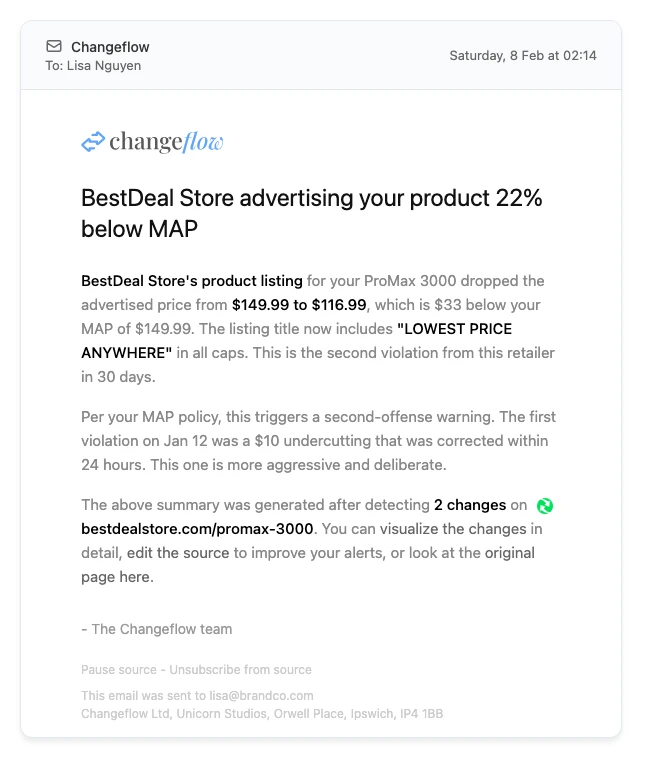
How it works:
- Add your retailers' product pages to Changeflow
- Tell the AI: "Alert me when the advertised price drops below $X"
- Get notifications when a violation occurs
- Take enforcement action with timestamped evidence
The advantage over manual checking: Changeflow runs 24/7. It catches violations at 2 AM on a Saturday. It logs exactly when the price changed and what it changed to. That evidence matters when enforcing your policy.
For brands with large retailer networks, pair Changeflow with dedicated price intelligence tools that specialize in product matching and marketplace monitoring. See our full guide on competitor price tracking tools for options at every budget.
What to Monitor
- Retailer product pages for advertised prices below MAP
- Google Shopping listings where prices appear in search results
- Amazon and marketplace listings from authorized and unauthorized sellers
- Email campaigns where retailers promote your products
- Social media ads with pricing claims
Set up automated change tracking for each retailer and product combination. When prices change, you'll know about it.
Why MAP Enforcement Matters
Without MAP enforcement, here's what typically happens:
The race to the bottom. One retailer drops their price to win traffic. Others follow. Within weeks, your product is being advertised at cost. Retailers make no margin and stop investing in your brand.
Channel conflict. Your premium retail partners (who invest in displays, trained staff, and customer experience) can not compete with online discounters. They drop your brand. Now you've lost the partners who actually sell your products well.
Brand erosion. When customers constantly see your product "on sale," they anchor to the sale price. The full price starts to feel like a ripoff. Your brand becomes associated with discounting, not quality.
The best brands treat MAP enforcement as a compliance function, not an afterthought. Monitor consistently. Enforce fairly. And use tools to make it manageable at scale.
Getting Started with MAP Monitoring
If you're a brand with a MAP policy (or thinking about creating one), here's where to start:
-
Audit your current exposure. List every retailer and marketplace where your products appear. You might be surprised how many unauthorized sellers are out there.
-
Set up automated monitoring. Use Changeflow to track retailer pricing pages. Start with your top 20 retailers and expand from there.
-
Document everything. Every violation, every communication, every enforcement action. This protects you legally and establishes a pattern for repeat offenders.
-
Enforce consistently. The biggest MAP mistake is selective enforcement. Apply your policy the same way to every retailer, big or small.
-
Review quarterly. MAP prices should reflect market conditions. Review and adjust your MAP schedule regularly to keep it relevant.
For more on building a monitoring workflow, explore our guides on monitoring competitor websites and dynamic pricing strategy. If you're also working with EDLP retailers, understanding their pricing model helps you set MAP prices that work across different retail strategies.
Catch MAP violations before they spread
Monitor retailer pricing pages automatically. Get alerts when advertised prices drop below your MAP.
Try Changeflow FreeNo credit card required
More from Learn

Wayback Machine for Legal Research: A Law Librarian's Guide
Half the URLs in old briefs are dead. Here is how law librarians use the Wayback Machine and stronger archives to verify citations, build timelines, and support litigation.

Law Librarian Current Awareness Audit Checklist (2026)
A 27-question audit covering coverage, cadence, relevance, distribution, resilience, and value. Built for law librarians and knowledge lawyers running current awareness at Am Law 200 firms.

Audit-Ready Web Archives: SEC 17a-4, FDA, and HIPAA Rules
Free archive tools fail under regulatory audit. Here is what SEC 17a-4, FDA 21 CFR Part 11, and HIPAA require from a web archive that holds up under examination.