
10 price intelligence tools compared — Prisync, Competera, Wiser, Changeflow, and more. Pricing, features, and where each one fits.

Your competitor raised their prices last quarter. You only found out when a prospect mentioned it during a demo.
That's the problem with flying blind on pricing. You're making decisions based on outdated information. And in markets where pricing shifts weekly, that gap hurts.
Price intelligence tools fix this. They collect competitor pricing data, track changes over time, and some even recommend what you should charge. But they're not all built for the same buyer. E-commerce tools need product catalogs. Enterprise platforms need six-figure budgets. And B2B companies? They've been stuck checking competitor websites manually.
This guide covers the best price intelligence tools for 2026, with honest pros, cons, and pricing. We built Changeflow, so it's on the list. But we'll tell you when a different tool is the better fit.
What Is Price Intelligence (and Why It Matters)
Price intelligence means systematically collecting, tracking, and analyzing competitor pricing data to inform your own pricing decisions.
At its simplest, that's knowing what competitors charge. At its most advanced, it's machine learning models that recommend optimal price points based on demand, competition, and market conditions.
Here's why it matters: McKinsey found that a 1% improvement in pricing leads to an 11% increase in profit. Not revenue. Profit. That makes pricing the single highest-impact lever most companies ignore.
And yet most B2B companies still check competitor prices manually. Open a browser. Screenshot a page. Paste it into a spreadsheet. Do it again next week. The data is always stale by the time anyone acts on it.
Price intelligence software automates that entire process.
Track competitor prices on any website
Changeflow monitors pricing pages and tells you exactly what changed. Set it up in 30 seconds.
Free plan available. No credit card required.
Quick Comparison: Price Intelligence Software
| Tool | Starting Price | Best For | Standout Feature |
|---|---|---|---|
| Changeflow | $99/mo | B2B, any website | AI change summaries |
| Prisync | $99/mo | E-commerce | Dynamic repricing |
| Competera | Custom ($50k+/yr) | Enterprise retail | ML pricing optimization |
| Price2Spy | $24/mo | Small catalogs | Price history charts |
| Intelligence Node | Custom | Brands/retailers | MAP enforcement |
| Minderest | From 59 euros/mo | European markets | Multi-country support |
| Omnia Retail | Custom | Multi-channel retail | Automation rules |
| Wiser | Custom | Retail & brands | In-store + online |
The Tools: Pricing Intelligence Platforms Compared
1. Changeflow
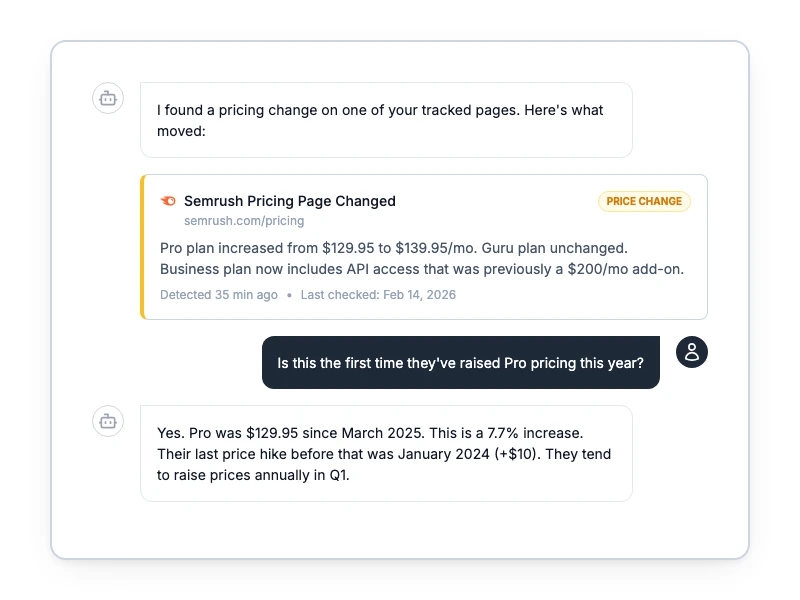
Best for: B2B companies tracking competitor pricing without structured product catalogs
Pricing: Free (3 sources) | Pro $99/mo | Business $249/mo | Enterprise custom
What it does: Changeflow monitors any webpage and uses AI to tell you what changed. Add a competitor's pricing page, tell the AI "alert me when prices or packaging change," and you get plain-English summaries when something updates. No product catalog needed.
Strengths:
- Works on any website (SaaS pricing pages, B2B quotes, unstructured content)
- AI summarizes exactly what changed so you don't have to diff it yourself
- Tracks more than price: feature changes, packaging shifts, new tiers
- Simple setup. Paste a URL, describe what you care about. Done.
- Visual diffs show exactly what's different
Limitations:
- No automated repricing (that's not what we do)
- No product catalog matching for e-commerce SKUs
- Better for B2B than high-volume retail with thousands of products
When to choose Changeflow: You're a B2B company and your competitors don't have structured data feeds. You want to know when their pricing page changes, what the new packaging looks like, or when they quietly drop a feature from a tier. See our pricing for plan details.
2. Prisync
Best for: E-commerce stores with product catalogs
Pricing: Professional $99/mo | Premium $199/mo | Platinum $399/mo
What it does: Prisync is a competitor price tracking tool built for e-commerce. Upload your product catalog, match products to competitor listings, and track prices across multiple competitors. It also offers dynamic repricing rules.
Strengths:
- Built for e-commerce product matching
- Dynamic repricing automation
- MAP pricing compliance monitoring
- Historical pricing data and trends
- Solid reporting dashboards
Limitations:
- Requires product catalog setup (not plug-and-play for B2B)
- Not useful for non-e-commerce pricing
- Gets expensive at scale
- Matching accuracy depends on your catalog quality
When to choose Prisync: You sell products online, have a catalog with SKUs, and want automated repricing or MAP monitoring. Good mid-market fit for stores with hundreds to thousands of products.
3. Competera
Best for: Enterprise retailers needing ML-powered pricing optimization
Pricing: Custom (typically $50k+/year)
What it does: Competera goes beyond price tracking into pricing optimization. It uses machine learning to recommend what you should charge based on demand elasticity, competitor behavior, and market positioning. This is a pricing intelligence platform, not a monitoring tool.
Strengths:
- ML-powered pricing recommendations
- Demand forecasting and elasticity modeling
- Cross-channel pricing optimization
- White-glove implementation and support
Limitations:
- Enterprise-only pricing (way out of budget for SMBs)
- 3-6 month implementation timeline
- Massive overkill for simple competitive monitoring
- Requires significant data integration work
When to choose Competera: You're a large retailer with a dedicated pricing team, complex product assortment, and budget for enterprise software. If you're just tracking a handful of competitor pricing pages, this is a sledgehammer for a nail.
4. Price2Spy
Best for: Small to mid-size businesses on a budget
Pricing: Starter $24/mo | Professional $66/mo | Premium $120/mo
What it does: Price2Spy provides straightforward price monitoring and alerting. Track competitor prices, view historical trends, get alerts on changes. No ML optimization, no fancy repricing. Just solid tracking.
Strengths:
- Affordable entry point ($24/mo)
- Price history charts and trend data
- Simple to get started
- Email and webhook alerts
- Decent for smaller product catalogs
Limitations:
- Interface feels dated compared to newer tools
- Limited repricing automation
- Support response times can be slow
- Reporting is basic
When to choose Price2Spy: You need price intelligence on a budget and have a small-to-medium catalog. Good starter tool before you need enterprise features.
5. Intelligence Node
Best for: Brands monitoring MAP compliance and retail pricing
Pricing: Custom (enterprise)
What it does: Intelligence Node focuses on competitive pricing intelligence for brands and retailers. Strong on MAP (Minimum Advertised Price) monitoring, assortment intelligence, and marketplace tracking.
Strengths:
- Strong MAP compliance monitoring
- Marketplace coverage (Amazon, Walmart, etc.). For dedicated Amazon price tracking, see our separate guide.
- Assortment and catalog intelligence
- Good for brand manufacturers watching retail partners
Limitations:
- Enterprise pricing only
- Focused on retail/CPG verticals
- Not suitable for B2B or SaaS pricing
When to choose Intelligence Node: You're a brand manufacturer and need to monitor whether retailers are violating your MAP pricing policies. Also good for large retailers tracking assortment gaps.
6. Minderest
Best for: European markets with multi-country needs
Pricing: From 59 euros/mo
What it does: Minderest provides pricing intelligence with strong European market coverage. Good multi-currency support, multi-country tracking, and localized pricing data.
Strengths:
- European market focus
- Multi-currency and multi-country
- Reasonable starting price
- Growing marketplace coverage
Limitations:
- Weaker in North American markets
- Smaller brand recognition than US competitors
- Feature set still catching up to Prisync/Competera
7. Omnia Retail
Best for: Multi-channel retailers needing pricing automation
Pricing: Custom (mid-market)
What it does: Omnia combines competitive pricing data with rules-based automation. Set pricing rules (always 5% below competitor X, never below margin threshold) and it adjusts automatically.
Strengths:
- Multi-channel pricing (web, marketplaces, in-store)
- Flexible automation rules
- Good European support
- Clean, modern interface
Limitations:
- Custom pricing only (no transparent tiers)
- Retail-focused, not useful for B2B
- Implementation takes time
8. Wiser
Best for: Brands and retailers who need in-store and online pricing data
Pricing: Custom
What it does: Wiser collects pricing data from both online and brick-and-mortar stores. They use a network of in-store auditors plus web scraping for online prices.
Strengths:
- In-store pricing data (rare among digital-first tools)
- Brand intelligence and shelf analytics
- Both online and offline coverage
Limitations:
- Enterprise pricing
- In-store data is US-focused
- Not self-service
How to Choose the Right Price Intelligence Tool
The right tool depends on what you sell and how your competitors price.
You're B2B or SaaS: Your competitors have pricing pages, not product feeds. You don't need SKU matching. You need website change detection that tells you when a pricing page updates. Choose Changeflow.
You're e-commerce with a product catalog: You need SKU-level tracking, repricing rules, and dynamic pricing automation. Choose Prisync (mid-market) or Competera (enterprise).
You're a brand watching retail partners: You need MAP compliance monitoring across retailers and marketplaces. Choose Intelligence Node or Wiser.
You're on a tight budget: Start with Price2Spy for basic monitoring or Changeflow for B2B website tracking.
You're a European retailer: Minderest or Omnia Retail have strong regional coverage.
For a broader view, see our guides on competitive intelligence tools and competitor price tracking.
Price Intelligence Use Cases by Business Type
E-Commerce
Track competitor prices across hundreds or thousands of SKUs. Set dynamic repricing rules. Monitor marketplace pricing (Amazon, Walmart). Watch for MAP pricing violations. Tools like Prisync and Intelligence Node handle this well.
B2B and SaaS
Monitor competitor websites for pricing and packaging changes. Know when a competitor adds a new tier, drops a feature, or changes their enterprise pricing. Changeflow is built for this. No product catalog needed. Just paste the URL.
Retail and CPG
Track shelf prices online and in-store. Monitor promotional pricing. Enforce MAP compliance across channels. Enterprise tools like Competera and Wiser cover this space.
Financial Services
Track competitor rates, fees, and product terms. Banks and insurers use EDLP-style pricing strategies that require constant market awareness. Changeflow works well here because financial pricing pages are unstructured and change frequently.
What Good Price Intelligence Looks Like
The best pricing intelligence platforms do three things:
1. Collect data reliably. If the tool misses a price change, everything downstream breaks. Look for tools with high check frequency and good coverage of the sites you care about. Some generic website monitoring tools offer price tracking as a side feature, but dedicated price intelligence software is usually more reliable for this.
2. Surface changes clearly. Raw data is useless if you have to dig for insights. The tool should tell you what changed, when, and by how much. The difference between a wall of HTML diffs and an AI summary that says "Competitor X raised their Pro plan from $99 to $129 and removed the API access from their Starter tier" is the difference between data and intelligence.
3. Make action easy. Whether that's automated repricing, Slack alerts to your pricing team, or a clean report for your weekly meeting. The gap between "knowing" and "doing" should be small.
If your current process involves screenshots, spreadsheets, and somebody remembering to check competitor sites every Monday, you're leaving money on the table.
Price Intelligence vs. Price Monitoring: What's the Difference?
People use these terms interchangeably. They're not the same.
Price monitoring is the data collection layer. A tool checks competitor prices on a schedule and records what it finds. That's it. You get data. What you do with it is your problem.
Price intelligence includes analysis. The tool (or the AI layer on top of it) identifies trends, flags important changes, and helps you act. Some platforms go further and recommend pricing actions based on market conditions and demand data.
Most small and mid-size businesses need monitoring with smart alerts. You don't need a $50k ML platform to know that your biggest competitor just raised prices 15%. You need a tool that notices the change and tells you about it clearly.
For B2B companies, this often means monitoring competitor websites for pricing page changes. For e-commerce, it means tracking SKU-level prices across competitor storefronts. Pick the tool that matches your actual workflow.
Start Tracking Competitor Pricing Today
Every week you don't know about a competitor's price change is a week you might be overpricing yourself out of deals or underpricing yourself out of margin.
Pick a tool from this list. If you're in B2B and want to track changes on any competitor's pricing page with AI summaries, Changeflow is free to try. No product catalog needed. No enterprise sales call. Just a URL and 60 seconds.
Track competitor pricing changes automatically
Get alerts the moment a competitor changes their pricing. Works on any website, even without a product catalog.
Try Changeflow FreeNo credit card required
More from Learn

Wayback Machine for Legal Research: A Law Librarian's Guide
Half the URLs in old briefs are dead. Here is how law librarians use the Wayback Machine and stronger archives to verify citations, build timelines, and support litigation.

Law Librarian Current Awareness Audit Checklist (2026)
A 27-question audit covering coverage, cadence, relevance, distribution, resilience, and value. Built for law librarians and knowledge lawyers running current awareness at Am Law 200 firms.

Audit-Ready Web Archives: SEC 17a-4, FDA, and HIPAA Rules
Free archive tools fail under regulatory audit. Here is what SEC 17a-4, FDA 21 CFR Part 11, and HIPAA require from a web archive that holds up under examination.