
The competitive intelligence tools worth evaluating in 2026 — website monitoring, market analysis, and competitor tracking, with honest picks per use case.

You're in a deal. The prospect mentions your competitor just dropped their price 20% and added a feature you don't have.
News to you.
That's what happens without competitive intelligence tools. You're always the last to know. And in competitive markets, being last means losing.
The good news: you don't need a six-figure budget or a dedicated CI team to stay informed. A handful of the right tools, set up properly, gives you a clear picture of what competitors are doing, often before your customers notice.
This guide covers the best competitive intelligence tools for 2026, organized by category. We'll show you what each one does, what it costs, and how to combine them into a CI stack that fits your team size and budget.
What Is Competitive Intelligence (And What It Isn't)
Competitive intelligence is the systematic collection and analysis of information about your competitors to make better business decisions. SCIP (Strategic & Competitive Intelligence Professionals) defines it as ethical, legal information gathering that goes beyond simple observation.
It is not corporate espionage. Everything covered here uses publicly available information.
The CI process follows a cycle:
- Plan - Decide what you need to know and why
- Collect - Gather information from multiple sources
- Analyze - Turn raw data into patterns and insights
- Share - Get intelligence to the people who can act on it
- Act - Make decisions based on what you've learned
Different tools serve different parts of this cycle. Some collect. Some analyze. A few try to do everything.
Monitor any competitor website
Changeflow watches competitor pages and sends you AI summaries of what changed.
Free plan available. No credit card required.
Quick Comparison: Competitive Intelligence Tools by Category
| Category | Tools | Starting Price | Best For |
|---|---|---|---|
| Website Monitoring | Changeflow, Visualping | $14-19/mo | Tracking competitor page changes |
| CI Platforms | Crayon, Klue, Kompyte | $25k+/yr | Enterprise CI programs |
| Social Listening | Mention, Brand24 | $49/mo | Brand and competitor mentions |
| Market Intelligence | Contify | Custom | News and industry monitoring |
| Sales Intelligence | ZoomInfo | $15k+/yr | Contact data and company intel |
| SEO Intelligence | Semrush | $130/mo | Search and content strategy |
| Price Monitoring | Prisync, Price2Spy | $24-99/mo | E-commerce pricing |
Website Monitoring Tools for Competitive Intelligence
These tools track changes on competitor websites, the most direct source of competitive intelligence. When a competitor updates their pricing, launches a feature, or changes their messaging, website monitoring catches it.
Changeflow
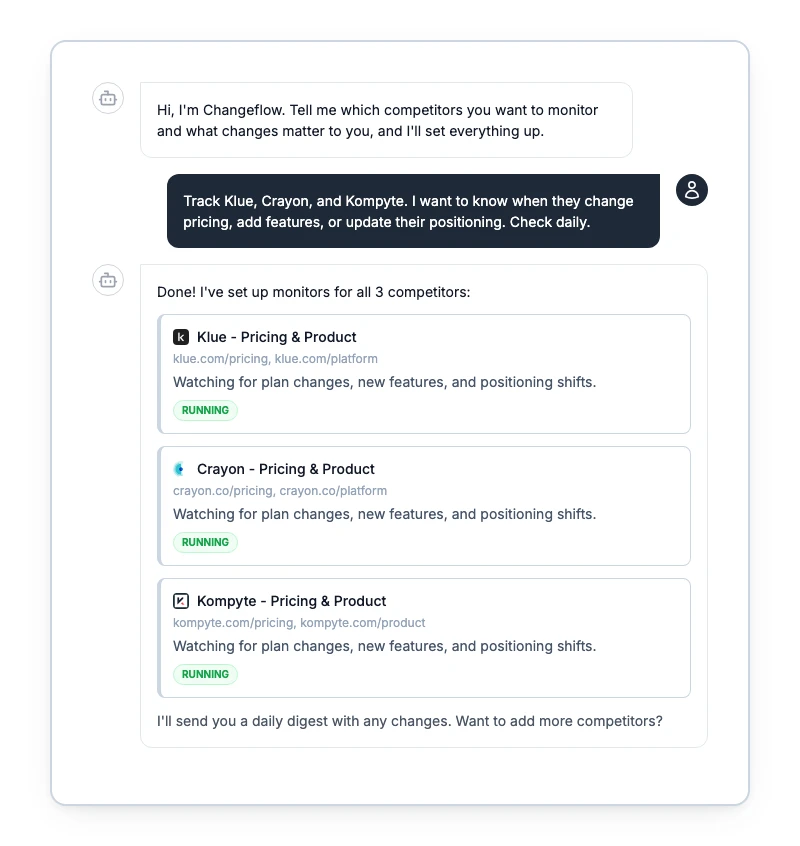
What it does: Changeflow monitors any webpage and sends you AI-powered summaries of what changed. Add a competitor's pricing page, product page, or job board. Tell the AI what you care about. Get alerts in email, Slack, or via webhook.
Price: Free (3 sources) | Pro $99/mo | Business $249/mo | Enterprise custom
Strengths:
- AI reads the page and tells you what changed in plain English
- Works on JavaScript-heavy sites, pages behind login, and bot-protected pages
- Simple setup (URL + description of what matters)
- Team workspaces and shared alerts
- Tracks any type of page change, not just prices
Limitations:
- Not a full CI platform (no social listening, no battle cards)
- Best for direct competitor website monitoring, not broad market scanning
Best for: Teams that want to monitor competitor websites without enterprise complexity. B2B companies where competitor information lives on specific webpages rather than structured data feeds.
Visualping
What it does: Takes screenshots of webpages and compares them visually. Alerts you when something looks different.
Price: Free (2 pages) | Starter $14/mo | Business $48/mo
Strengths: Easy setup, visual comparisons, affordable entry point.
Limitations: No AI summaries (shows raw visual diffs), noisy on dynamic pages, limited filtering. See our detailed Changeflow vs Visualping comparison.
ChangeTower
What it does: Monitors webpages for text and visual changes. Offers scheduled checks and email alerts.
Price: Free (limited) | From $9/mo
Strengths: Affordable, basic change detection. Limitations: Less accurate on complex pages, no AI analysis, limited team features. See the full ChangeTower comparison.
CI Platforms (Enterprise)
These are all-in-one platforms designed for dedicated competitive intelligence teams. They aggregate data from many sources and organize it into battle cards, newsletters, and reports.
Crayon
What it does: Crayon automatically collects competitive intelligence from websites, social media, review sites, SEC filings, job postings, and more. It uses AI to surface the most important changes and helps teams create battle cards for sales.
Price: Custom (typically $30k-100k+/year)
Strengths:
- Broadest automated collection across many source types
- AI-powered signal detection and prioritization
- Battle card creation and management
- Integration with CRM and sales tools
- Regular industry benchmarking via their State of CI report
Limitations:
- Enterprise pricing puts it out of reach for small teams
- Requires dedicated time to configure and maintain
- Can generate information overload without careful tuning
Best for: Companies with a dedicated CI role or team and the budget for enterprise software.
Klue
What it does: Klue focuses on competitive enablement for sales teams. It collects competitive intel and packages it into battle cards, win/loss analysis, and competitive content that reps can use in deals.
Price: Custom (similar range to Crayon)
Strengths:
- Strong sales enablement focus
- Battle card templates and workflows
- Win/loss analysis integration
- Good Salesforce integration
Limitations:
- Sales-focused, less useful for product or marketing CI
- Enterprise pricing
- Requires ongoing content curation
Best for: Sales-driven organizations where the primary goal is winning competitive deals.
Kompyte (by Semrush)
What it does: Kompyte automates competitor tracking across websites, social media, and ads. Now part of Semrush's suite, it feeds into their broader competitive analysis platform.
Price: Custom (mid-market to enterprise)
Strengths: Good automation, integrates with Semrush data, tracks ads and social alongside web changes. Limitations: Acquired by Semrush, so the standalone product's future is uncertain.
Social Listening and Market Intelligence Tools
These CI tools monitor what's being said about competitors (and you) across the web, social media, news outlets, and forums.
Mention
What it does: Mention tracks mentions of any keyword (your brand, competitors, industry terms) across social media, news, blogs, forums, and review sites.
Price: Solo $49/mo | Pro $99/mo | ProPlus $179/mo
Strengths:
- Real-time mention tracking across many channels
- Sentiment analysis
- Competitive benchmarking reports
- Alerts and digest emails
- Good for tracking brand reputation alongside competitor mentions
Limitations:
- Does not track actual webpage changes (complements website monitoring)
- Can miss mentions on platforms with limited API access
- Gets noisy for common brand names
Brand24
What it does: Similar to Mention, Brand24 monitors online mentions and provides sentiment analysis, influencer identification, and competitive benchmarking.
Price: Individual $49/mo | Team $129/mo | Pro $199/mo
Strengths: Good mention coverage, discussion volume charts, topic analysis. Limitations: Overlap with Mention in features, better for B2C brands with high social volume.
Contify
What it does: Contify is a market and competitive intelligence platform focused on news, company updates, and industry developments. It curates information from thousands of sources and delivers it in custom newsletters and feeds.
Price: Custom
Strengths: Strong news and market intelligence, custom taxonomy, good for regulated industries. Limitations: Custom pricing, less real-time than social listening tools.
Sales and Data Intelligence Tools
ZoomInfo
What it does: ZoomInfo provides B2B contact data, company intelligence, technographic data, and intent signals. While primarily a sales tool, the company data and hiring signals are valuable for competitive intelligence.
Price: From $15k/year
Strengths:
- Massive B2B contact and company database
- Technographic data (what software competitors use)
- Hiring and intent signals
- Org charts and decision-maker identification
Limitations: Expensive, primarily a sales prospecting tool, data accuracy varies.
Best for: Sales teams that need contact data alongside competitive intelligence. Not a replacement for website monitoring or market analysis.
SEO and Content Intelligence
Semrush
What it does: Semrush provides SEO tools including competitor keyword analysis, backlink tracking, content gap analysis, ad monitoring, and market share estimation based on search visibility.
Price: Pro $130/mo | Guru $250/mo | Business $500/mo
Strengths:
- Deep keyword and search intelligence
- Competitor ad copy monitoring
- Content gap and backlink analysis
- Market position tracking via search visibility
Limitations: SEO-focused, not a general CI tool. Does not track actual page content changes.
Best for: Marketing teams that want to understand competitor search strategy and content performance.
Price Monitoring Tools
For competitive intelligence on pricing specifically, there's a whole category of specialized tools. We cover these in detail in our competitor price tracking tools guide, but here's the summary:
- Prisync ($99/mo+) - E-commerce price monitoring with repricing automation
- Price2Spy ($24/mo+) - Budget-friendly price tracking for smaller catalogs
- Competera (enterprise) - ML-powered pricing optimization for large retailers
For broader price intelligence, including MAP compliance and dynamic pricing, these tools pair well with general website monitoring.
How to Build a CI Stack for Your Team Size
Not every team needs Crayon and ZoomInfo. Here's what works at different scales.
Solo Founder or Small Team (Under 10 People)
Budget: Under $100/month
Stack:
- Changeflow ($99/mo) - Monitor competitor websites for pricing, feature, and content changes
- Google Alerts (free) - Track competitor brand mentions in news
- Semrush (free tier or $130/mo) - Check competitor keywords and search visibility quarterly
- Spreadsheet (free) - Log patterns and track changes over time
Time commitment: 2 hours per month reviewing alerts and updating your competitive brief.
This is honestly enough for most startups and small teams. You'll catch 80% of what matters.
Mid-Size Team (10-100 People)
Budget: $200-500/month
Stack:
- Changeflow ($249/mo Business) - Team workspaces, API access, faster checks
- Mention or Brand24 ($49-99/mo) - Social and web mention monitoring
- Semrush ($130/mo) - Ongoing keyword and content intelligence
- Notion or Confluence - Internal competitive knowledge base
Time commitment: Someone owns CI part-time. 4 to 6 hours per month collecting, analyzing, and sharing insights.
Enterprise (100+ People)
Budget: $50k+/year
Stack:
- Crayon or Klue ($30k-100k/yr) - Full CI platform with battle cards and automation
- Changeflow (Enterprise) - Deep website monitoring for specific high-value pages
- ZoomInfo ($15k+/yr) - Contact and company intelligence
- Semrush ($500/mo) - Full SEO competitive intelligence
- Contify (custom) - Market and news intelligence for regulatory monitoring and industry tracking
Time commitment: Dedicated CI analyst or team. Weekly competitive briefings. Quarterly competitive reviews.
The CI Process: Making Intelligence Actionable
Tools are just the collection layer. SCIP and experienced CI practitioners all say the same thing: the value is in the analysis and action, not the data.
According to Gartner, companies that systematically act on market intelligence outperform those that collect but don't distribute it.
Here's a simple process that works:
Weekly: Review automated alerts from your monitoring tools. Flag anything significant.
Monthly: Write a one-page competitive brief. What changed? What patterns are emerging? What should we do about it?
Quarterly: Deep-dive competitive review. How has each competitor's strategy shifted? Where are opportunities?
Per deal (sales): Pull relevant competitive intelligence into a brief or battle card before key sales conversations.
How to Choose the Right Competitive Intelligence Tools
Ask yourself three questions:
1. What's your primary CI need?
- Tracking competitor website changes → Changeflow or similar monitoring tool
- Sales enablement and battle cards → Klue or Crayon
- Brand monitoring and social listening → Mention or Brand24
- Search and content strategy → Semrush
2. What's your budget?
- Under $50/mo → Changeflow + Google Alerts
- $100-500/mo → Add social listening and SEO tools
- $25k+/year → Enterprise CI platform
3. Who will use it?
- Just you → Keep it simple, 1 to 2 tools max
- Sales team → Needs battle cards, CRM integration
- Marketing team → Needs content and search intelligence
- Dedicated CI team → Full platform with workflow automation
Most teams start with website monitoring because it provides the most direct, actionable intelligence. When a competitor changes their pricing page, that's something you can act on today. Track what matters first, then expand your stack.
For hands-on setup advice, see our guide on how to monitor competitor websites. For competition tracking strategy and frameworks, we cover that separately.
Start Building Your CI Stack
You don't need every tool on this list. You need the right 2 or 3.
Start with the source of truth: competitor websites. That's where pricing lives, where product changes appear, where hiring signals show up. Everything else is secondary.
Changeflow handles the website monitoring piece. Add a competitor URL, tell the AI what you care about, get alerts when things change. Used by competitive intelligence and compliance teams in regulated industries.
Start building your CI stack
Changeflow monitors competitor websites and sends plain-English summaries of what changed. The website monitoring piece of your CI stack, handled.
Try Changeflow FreeNo credit card required
More from Learn

Wayback Machine for Legal Research: A Law Librarian's Guide
Half the URLs in old briefs are dead. Here is how law librarians use the Wayback Machine and stronger archives to verify citations, build timelines, and support litigation.

Law Librarian Current Awareness Audit Checklist (2026)
A 27-question audit covering coverage, cadence, relevance, distribution, resilience, and value. Built for law librarians and knowledge lawyers running current awareness at Am Law 200 firms.

Audit-Ready Web Archives: SEC 17a-4, FDA, and HIPAA Rules
Free archive tools fail under regulatory audit. Here is what SEC 17a-4, FDA 21 CFR Part 11, and HIPAA require from a web archive that holds up under examination.