Archive.is is blocked in many countries and has no alerts. These 10 alternatives let you archive, monitor, and track changes on any webpage automatically.

Archive.is is one of the best free web archiving tools out there. You paste a URL, hit save, and it creates a permanent snapshot. Simple.
But it has problems. It's blocked in some countries. It's slow during peak hours. There's no way to monitor pages for ongoing changes. And if you need archive.is alternative options for business, legal, or research use, the feature set falls short quickly.
Good news: there are solid alternatives. Some are free. Some are built for specific use cases like legal archiving or compliance monitoring. This guide covers the best archive.is alternatives for 2026, organized by what you actually need.
Why People Look for Archive.is Alternatives
Before we get to the tools, here's why you might need something different.
Access issues. Archive.is (also known as archive.today, archive.ph, archive.li) is blocked by some ISPs and in certain countries. The service has an ongoing dispute with Cloudflare's DNS resolver (1.1.1.1), which means users on Cloudflare DNS can't reach it without workarounds.
Speed. During busy periods, Archive.today can be painfully slow to create new snapshots. Sometimes it takes minutes. Sometimes it times out entirely.
No ongoing monitoring. Archive.is takes one snapshot at a time. You save a page, and that's it. There's no way to automatically track changes over time or get alerts when a page updates.
Limited organization. No folders. No tags. No way to organize archives by project or client. You get a list of URLs with timestamps.
Business features missing. No team accounts. No API access (or very limited). No integration with Slack or email alerts. No AI analysis of what changed. For businesses, these gaps matter.
Paste a URL. We'll do the rest.
Changeflow monitors the page and tells you what changed and why it matters.
Free plan available. No credit card required.
Quick Comparison: Archive.is Alternatives
| Tool | Price | Best For | Key Difference |
|---|---|---|---|
| Wayback Machine | Free | General research | 890+ billion pages archived |
| Changeflow | From $99/mo | Business monitoring | Auto-archives + AI alerts |
| Google Cache | Free | Recent snapshots | Google's crawl cache |
| CachedView | Free | Quick lookups | Searches multiple caches |
| Conifer | Free (5GB) | Interactive pages | Captures JavaScript sites |
| ArchiveBox | Free (self-host) | Personal archives | Your own archive service |
| Perma.cc | Free (limited) | Academic citations | Permanent citation links |
| PageFreezer | Enterprise | Legal/compliance | Court-admissible archives |
| Stillio | From $29/mo | Visual screenshots | Scheduled page captures |
| Time Travel | Free | Research | Searches many archives |
Free Archive.is Alternatives
1. Wayback Machine (archive.org)
Price: Free Best for: General web research and historical lookups
The Wayback Machine from the Internet Archive is the biggest web archive on the planet. Over 890 billion pages. Going back to 1996. It crawls the web automatically and also lets you save pages on demand with its "Save Page Now" feature.
Strengths:
- Massive historical archive (nothing else comes close)
- Free with no limits on lookups
- "Save Page Now" for on-demand archiving
- Full-text search across archived pages
- API available for developers
Limitations:
- Some sites block the crawler via robots.txt
- Archives can be weeks or months old
- Site owners can request removal of their pages
- No change alerts or monitoring
- No private archives
vs. Archive.is: Wayback Machine has far more historical data but archives less frequently. Archive.is gives you exactly what you ask for, on demand. For historical research, Wayback wins. For saving a specific page right now, both work. Law firms running both for cite-checking and litigation timelines should also see our guide on the Wayback Machine for legal research. For more options, the full Wayback Machine alternatives guide covers paid and self-hosted picks too.
2. Google Cache
Price: Free Best for: Finding recent page versions
Google keeps cached copies of pages it crawls. You can access them by searching cache:example.com or clicking "Cached" in search results (where still available).
Strengths: Often has recent versions (days old), fast and reliable, no extra tools needed.
Limitations: Google has been removing cache features since 2024. Only stores one version (the most recent crawl). No history, no comparison, no alerts.
vs. Archive.is: Google Cache is faster but only keeps one recent snapshot. Archive.is keeps permanent archives. If you need history, Archive.is wins. If you just need to see what a page looked like yesterday, Google Cache might still work.
3. CachedView
Price: Free Best for: Finding any available cached version of a page
CachedView searches multiple cache sources simultaneously. Enter a URL and it checks Google Cache, Wayback Machine, and other sources for any available archived version.
vs. Archive.is: CachedView doesn't create archives. It finds existing ones. Use it when a page is down and you need to find any cached copy.
4. Conifer (formerly Webrecorder)
Price: Free (5GB) | Paid plans available Best for: Archiving interactive and JavaScript-heavy pages
Conifer captures websites as you browse them. Unlike static archivers that save HTML, Conifer records your browsing session, preserving interactive elements, JavaScript-rendered content, and dynamic pages.
Strengths:
- Captures JavaScript-heavy sites that other tools miss
- Records interactive elements (dropdowns, tabs, embedded content)
- Free tier with 5GB storage
- Open source
- Great for social media archiving
Limitations:
- Manual process (you browse, it records)
- Storage fills up quickly with media-heavy pages
- No automated monitoring
vs. Archive.is: Conifer handles dynamic content that Archive.is cannot capture. If you need to archive a single-page app or interactive dashboard, Conifer is the better choice.
Web Archiving Tools for Business
5. Changeflow
Price: Free (3 sources) | Pro $99/mo | Business $249/mo | Enterprise custom Best for: Ongoing website monitoring with automatic archiving
Here's the thing about Archive.is: it's built for one-time snapshots. You save a page. Done. But if you need to know when something changes, when a competitor updates pricing, when a regulator posts new guidance, when a legal filing gets updated, you need more than snapshots.
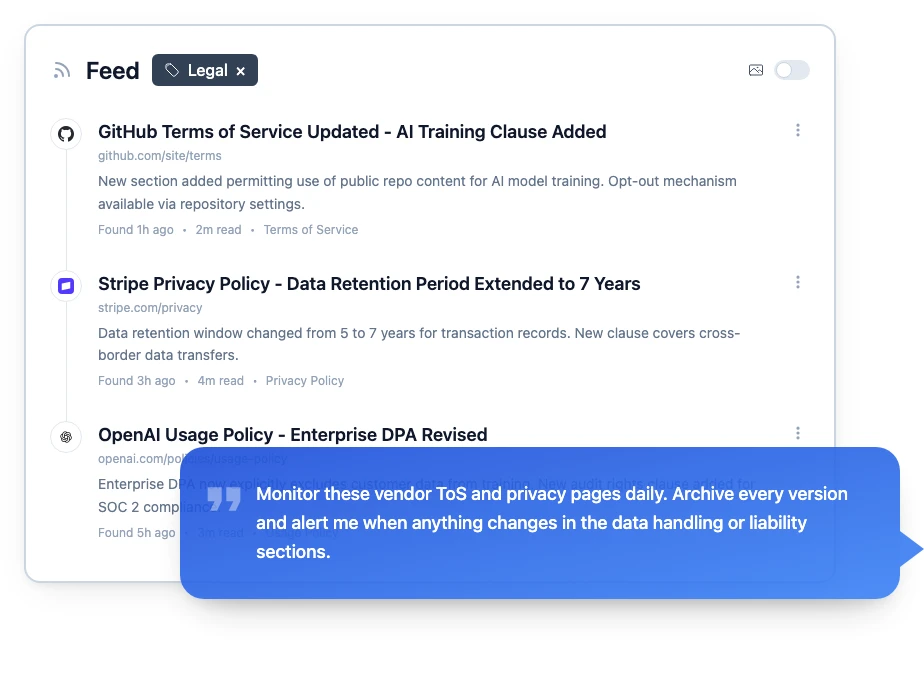
Changeflow monitors websites automatically. Every time it checks a page, it archives that version. When something changes, AI summarizes what's different and sends you an alert. You get a timeline of every version, with diffs showing exactly what changed.
Strengths:
- Automatic monitoring and archiving (set it, forget it)
- AI summarizes changes in plain English
- Visual diffs and side-by-side comparisons
- Timestamped archives with proof
- Works on JavaScript-heavy sites and SPAs that Archive.is struggles with
- Organized by project, client, or topic
- Alerts via email, Slack, and webhooks
Limitations:
- Paid for serious use (free tier covers 5 pages)
- Archives start when you set up tracking (no historical data)
- Not a public archive like Wayback or Archive.is
vs. Archive.is: Archive.is is for saving a specific page right now. Changeflow is for watching pages over time and knowing when they change. Different tools for different jobs. If you just need a one-time snapshot, Archive.is is fine. If you need ongoing monitoring with compliance-grade archives, Changeflow is the better fit. Check our pricing for plan details.
6. PageFreezer
Price: Enterprise (contact for pricing) Best for: Legal and regulatory compliance
PageFreezer creates legally defensible website archives. Every archive includes chain-of-custody documentation, digital signatures, and timestamps that hold up in court. Used by legal teams, compliance departments, and government agencies.
Strengths: Court-admissible archives, social media archiving, eDiscovery integration, SOC 2 certified.
Limitations: Enterprise pricing only, complex implementation, overkill for research or casual archiving.
vs. Archive.is: If you need archives that will hold up as legal evidence, PageFreezer is the choice. Archive.is snapshots are useful for reference but aren't built to meet legal chain-of-custody requirements. For compliance teams under SEC 17a-4, FDA 21 CFR Part 11, or HIPAA, see our checklist on audit-ready web archives.
7. Stillio
Price: Basic $29/mo | Plus $59/mo | Pro $99/mo Best for: Scheduled visual screenshots
Stillio takes automated screenshots of websites on a schedule. Daily, weekly, or hourly captures. It's focused on visual proof rather than content extraction.
Strengths: Scheduled captures, visual archives, simple interface, good for brand monitoring.
Limitations: Screenshots only (no text extraction or change detection), no AI analysis, storage-intensive.
vs. Archive.is: Stillio automates the process of capturing pages visually. Archive.is requires you to manually request each snapshot. If you need regular visual records of specific pages, Stillio saves time.
Self-Hosted and Academic Alternatives
8. ArchiveBox
Price: Free (open source) Best for: Technical users who want their own archive
ArchiveBox lets you run your own web archiving service. Self-hosted, open source, fully under your control. It saves pages in multiple formats: HTML, PDF, screenshot, WARC, and more.
Strengths:
- Full control over your data
- Multiple output formats
- Self-hosted privacy
- Active open-source community
- Import bookmarks, RSS feeds, or URL lists
Limitations:
- Requires technical setup (Docker, command line)
- You manage hosting and storage
- Community support only
- No built-in change detection
vs. Archive.is: ArchiveBox gives you Archive.is-like functionality that you host and control yourself. If data sovereignty or privacy matters to you, ArchiveBox is the self-hosted answer.
9. Perma.cc
Price: Free (10 links/mo) | Institutional plans available Best for: Academic citations and legal references
Perma.cc was built by Harvard Law School Library to solve link rot in citations. When you cite a web source in an academic paper or legal brief, Perma creates a permanent, unchangeable archive with a permanent URL.
Strengths: Purpose-built for citations, backed by major libraries, permanent URLs, legally recognized.
Limitations: Limited free tier (10 links/month), designed for citations not general archiving, no monitoring.
vs. Archive.is: Both create permanent snapshots. Perma.cc is specifically designed for citation permanence with institutional backing. Archive.is is more general-purpose. For academic or legal citations, Perma.cc is the more credible source.
10. Time Travel (Memento)
Price: Free Best for: Searching across multiple web archives at once
Time Travel (timetravel.mementoweb.org) searches multiple web archives simultaneously. Enter a URL and a date, and it finds the closest available archived version across Wayback Machine, Archive.today, and dozens of other archives.
vs. Archive.is: Time Travel doesn't create archives. It finds them. Think of it as a search engine for web archives. Useful when you need to find any available snapshot of a page from a specific date.
Snapshots vs. Monitoring: Which Do You Actually Need?
This is the question most people skip. And it matters.
Snapshot tools (Archive.is, Wayback Machine, Conifer, Perma.cc) save a page at a specific moment. You request it, you get a frozen copy. Great for preserving evidence, citing sources, or saving a page before it disappears.
Monitoring tools (Changeflow, PageFreezer, Stillio) watch pages over time and tell you when something changes. They archive automatically as a byproduct of monitoring. You don't have to remember to save anything.
If you're a researcher saving a source for a paper, you want snapshots. If you're a business that needs to know when a competitor changes their website, you want monitoring. Some tools, like general-purpose website change detectors, try to do both. But most do one better than the other.
The honest answer: most people searching for "archive.is alternative" actually need monitoring, not just better snapshots. They want to know when something changes, not just save what it looks like right now.
Which Archive.is Alternative Should You Use?
For quick, one-time page saves: Use the Wayback Machine's "Save Page Now" feature or Conifer. Both are free and handle the basic use case Archive.is covers.
For ongoing website monitoring: Use Changeflow. It archives pages automatically, detects changes with AI, and alerts you. This is what Archive.is can't do. If you need to track changes over time, not just save snapshots, this is the category you're in.
For legal and compliance archives: Use PageFreezer for court-admissible evidence or Changeflow for compliance monitoring with timestamped proof. Law firms use it for eDiscovery evidence preservation and website archiving compliance.
For academic citations: Use Perma.cc. It's purpose-built for this and recognized by courts and academic institutions.
For privacy and control: Self-host ArchiveBox. Your data, your servers, your rules.
For finding existing archives: Use Time Travel to search across multiple archive services at once. Also check our Internet Archive alternatives guide.
Archive.is Is Good. But It's Not Enough for Business.
Archive.is does one thing well: save a permanent snapshot of a page when you ask it to. That's useful. But business needs go beyond one-time snapshots.
You need to know when pages change. You need organized archives by client or project. You need alerts, diffs, and AI summaries. You need something that works even when Archive.is is blocked or slow. Whether you're tracking government website changes, monitoring SEC filings, or keeping up with regulatory changes in financial services, you need a tool built for the job.
Changeflow watches websites for you, archives every version, and tells you when something changes. Set it up in 60 seconds. No manual saving required.
Monitor and archive websites automatically
Changeflow watches websites, archives every version, and alerts you when something changes. No manual saving required.
Try Changeflow FreeNo credit card required
More from Learn

Wayback Machine for Legal Research: A Law Librarian's Guide
Half the URLs in old briefs are dead. Here is how law librarians use the Wayback Machine and stronger archives to verify citations, build timelines, and support litigation.

Law Librarian Current Awareness Audit Checklist (2026)
A 27-question audit covering coverage, cadence, relevance, distribution, resilience, and value. Built for law librarians and knowledge lawyers running current awareness at Am Law 200 firms.
Audit-Ready Web Archives: SEC 17a-4, FDA, and HIPAA Rules
Free archive tools fail under regulatory audit. Here is what SEC 17a-4, FDA 21 CFR Part 11, and HIPAA require from a web archive that holds up under examination.